

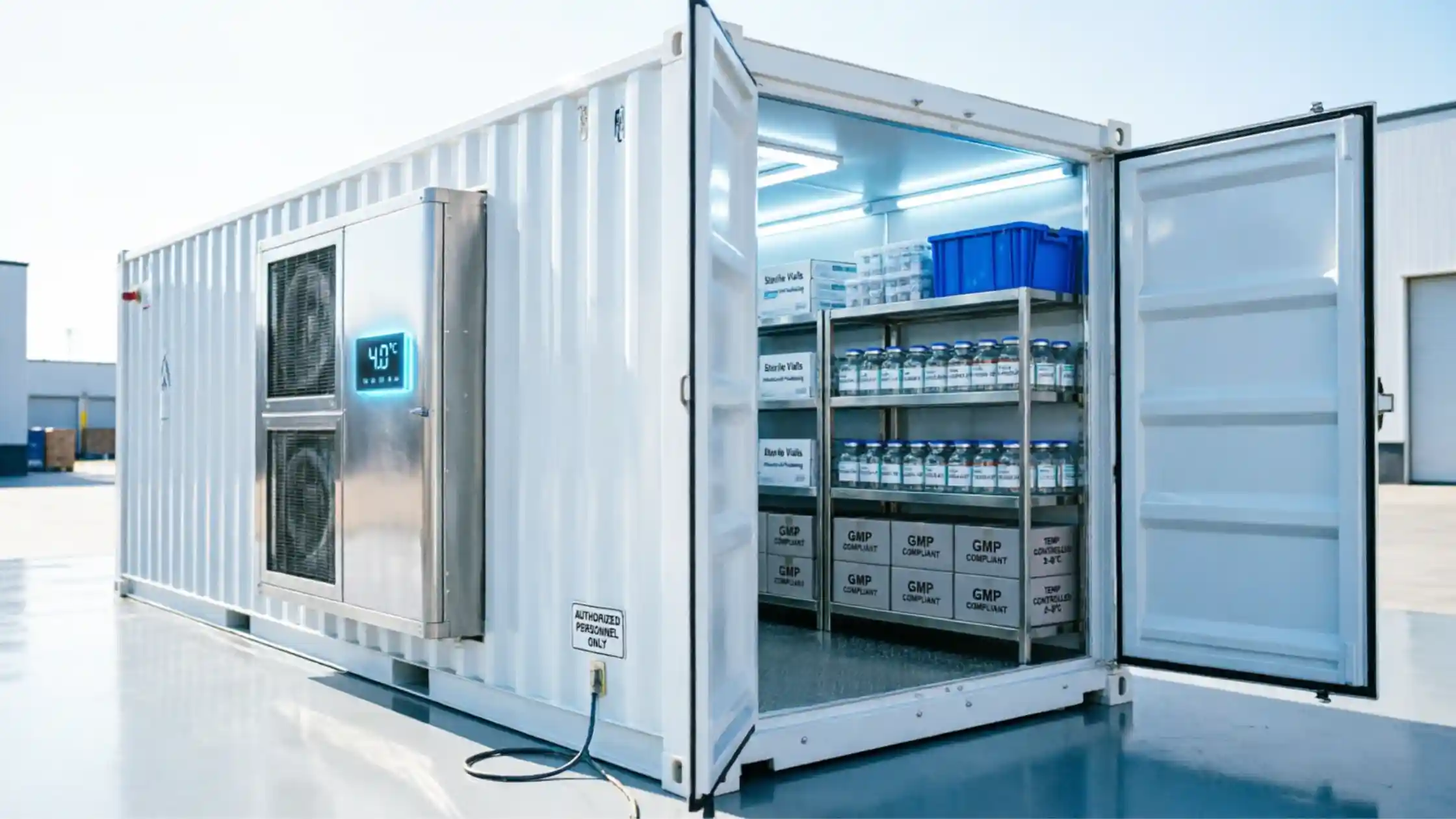
A container cold room for pharma storage is a converted shipping container fitted with validated refrigeration, redundant power and continuous temperature monitoring, built to hold medicines, vaccines and biologics within a fixed range — commonly 2–8°C or 15–25°C — without a single deviation. For pharma distributors, hospitals and logistics operators across the UAE, it’s the fastest route to compliant cold storage capacity, without the twelve-month wait for a purpose-built warehouse extension.
Key facts at a glance
- Temperature zones in standard pharmaceutical industry: 2-8°C (biological/vaccines) and 15-25°C (stock at controlled room temperature)
- Good Distribution Practice (GDP) guidelines to ensure compliance
- Time frame for implementation: Days/weeks, not months like construction of fixed cold storage
- Necessary specifications: Data logging, back-up cooling facility, backup power supply, temperature mapping, calibration reports
- Available sizes: 10ft, 20ft, 40ft, and 40ft high cube containers, single- or multi-zone
Pharmaceutical products don’t forgive shortcuts. A few hours outside the approved temperature band can degrade a vaccine batch, void a shipment’s release certificate or trigger a recall that costs far more than the storage itself. That’s why “cold room” and “pharma-grade cold room” are not the same product — and why this guide focuses specifically on what makes a container cold room fit for regulated pharmaceutical storage, not just food or flowers.
What Makes Pharma Storage Different From Standard Cold Storage?
- Standard commercial cold rooms are designed to maintain produce or dairy products in comfortable conditions. Pharmacy storage facilities are evaluated based on a more stringent and audited standard. Companies and hospitals working in the UAE have to comply with the Good Distribution Practice (GDP) requirements, which are the regulations about how medicine should be stored, controlled, and transported to maintain its quality along the chain until the end user. For more information on the field this falls into, read the Wikipedia page on the cold chain.
- In order to meet the standard in a container cold room, it is necessary to have:
- Tight temperature bands — typically 2–8°C for vaccines and biologics, 15–25°C for controlled room temperature stock, with minimal drift even during compressor cycling.
- Continuous monitoring and data logging — every reading recorded, time-stamped, and retrievable for audit, not just visible on a dial.
- Redundant cooling and backup power — a single compressor or grid failure should never mean product loss.
- Alarm systems — immediate local and remote alerts on any deviation, so staff can act within minutes, not after the next inspection.
- Documented validation — temperature mapping, qualification records, and calibration certificates that a QA auditor or regulator can request at any time.
A cold room without these five elements might keep produce fresh. It won’t pass a pharma audit.
How Are Container Cold Rooms Built for Pharma Compliance?
We design and manufacture our container cold rooms with pharmaceutical storage as one of the core use cases, not an afterthought. Every unit intended for pharma use is engineered around three priorities: precision, redundancy and proof.
Precision control. High-grade compressors, digital thermostats and dense insulation panels keep internal temperatures stable within a narrow band, even against Dubai and Abu Dhabi’s peak summer heat load. For operators who need separate zones — say, 2–8°C vaccine storage alongside 15–25°C stock in the same footprint — our temperature-controlled containers can be configured with multiple independently regulated compartments.
Redundancy and backup. Pharma units are fitted with dual compressor options and can be paired with a backup generator or UPS, so a mains outage doesn’t become a stock-loss event. We’ve built the same failover logic into our reefer container line for clients moving temperature-sensitive cargo, and it carries over directly to static pharma storage.
Monitoring and validation. Digital data loggers with remote alert capability track temperature continuously and generate exportable logs for your QA file. Before handover, units undergo temperature mapping across empty and loaded states, giving you the qualification documentation an auditor will expect to see on day one — not something you have to commission separately after installation.
Physical integrity. Corrosion-resistant steel shells, sealed door gaskets, and hygienic interior finishes reduce contamination risk and simplify cleaning validation, a detail that matters as much for a pharma cold room as it does for our container chiller units built for food-grade use.
Who Needs a Pharma-Grade Container Cold Room?
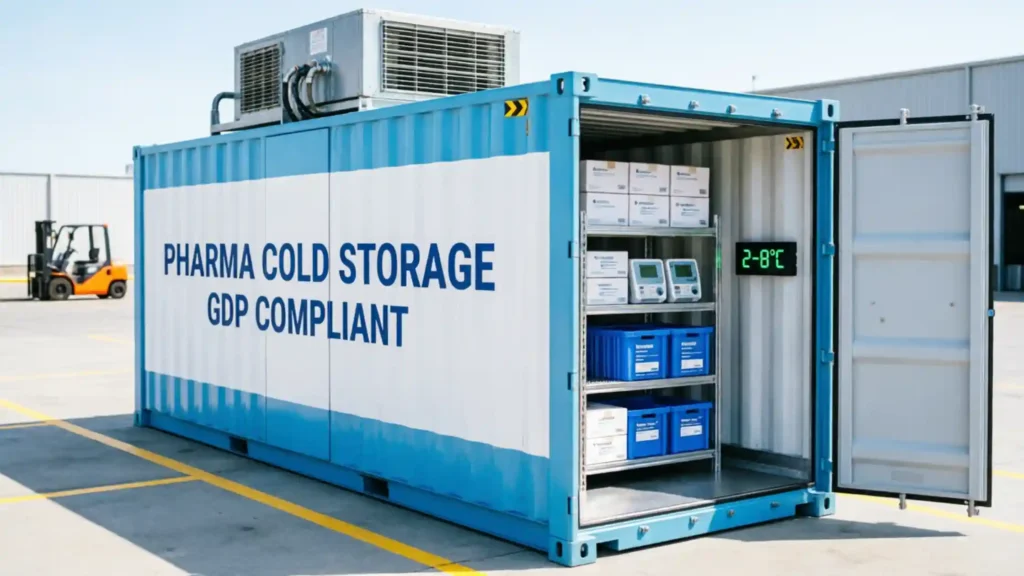
Container cold rooms for pharma storage work well for:
- Pharmaceutical distributors and 3PLs needing to expand cold storage capacity at a distribution hub without a lengthy construction project.
- Hospitals and clinics requiring buffer or backup vaccine and medicine storage on-site, separate from in-house pharmacy fridges.
- Clinical trial logistics providers who need temporary, relocatable, validated storage at a trial site.
- Import/export and freight forwarding companies handling pharma cargo transiting through UAE ports and needing compliant holding storage between legs of a shipment.
- Government and NGO health procurement programs moving vaccines and medical supplies into UAE or onward into African and South Asian markets, where a container-based unit can be relocated as the program’s storage needs shift.
The common thread is speed and flexibility: a container cold room can be manufactured, tested, and delivered in a fraction of the time a fixed warehouse extension takes and it can be relocated if your storage needs move.
How Do I Get a Custom Quote for Pharma Cold Storage?
Because pharma storage specs vary by product line and regulatory scope, we don’t run one fixed price list — every quote is built around your actual requirements. To give you an accurate number quickly, we’ll typically ask about:
- Required temperature range(s) and whether you need single- or multi-zone storage
- Internal storage capacity (container size — 10ft, 20ft, or 40ft)
- Site location and power availability (grid, generator, or both)
- Monitoring and reporting requirements — do you need remote alerts, integration with an existing BMS or standalone logging
- Any specific regulatory documentation you’ll need at handover (temperature mapping reports, IQ/OQ/PQ records, calibration certificates)
Send us these details through our contact page or WhatsApp and we’ll return a tailored quote — usually within one to two business days — along with a proposed specification sheet so your procurement or QA team can review it before you commit.
A Track Record Built on Cold Chain, Not Just Containers
ContainerColdroom.ae operates as a division of Technocrew Technical Services LLC, and pharma-grade storage sits alongside our work in food, floral, and logistics cold chain — you can see the breadth of that experience on our about us page. We’ve also written in more depth on the general case for pharmaceutical cold chain storage in the UAE, if you want the wider industry context before diving into specification and pricing.
Getting Started
If you’re evaluating container cold rooms for pharma storage, the most useful next step is usually a short call rather than a generic brochure. Tell us your temperature range, capacity, and compliance requirements and we’ll walk you through a configuration and a custom quote built around your actual operation — not a one-size-fits-all listing price.
1. What temperature range can a container cold room for pharma storage maintain?
Most pharma-grade units are configured for 2–8°C for vaccines and biologics, or 15–25°C for controlled room temperature products. We can build multi-zone units that hold both ranges simultaneously in separate compartments within the same container.
2. Are your container cold rooms GDP-compliant?
Our pharma-configured units are built with the monitoring, redundancy and documentation features that support Good Distribution Practice storage requirements, including continuous data logging and temperature mapping records. Final GDP certification for your operation depends on your own processes and local regulatory review, so we recommend sharing your compliance checklist with us before finalizing a spec.
3. What is the duration of delivery and installation of container cold room?
The delivery period will vary depending on the size of the container and the extent of customization, but one thing that always holds true is that deployment of a container cold room will be quicker than building a cold room facility.
6. What size options are available?
We build pharma cold rooms from 10ft and 20ft containers up to 40ft and 40ft high cube units, depending on the storage volume you need. We can also advise on capacity based on pallet count or product volume.
8. Is remote temperature monitoring available?
Yes. Digital data loggers can be configured to send remote alerts to your team’s phone or email the moment a reading drifts outside the approved range, and logs can be exported for reporting.
9. Do you supply pharma cold rooms for markets outside the UAE, such as Africa?
Yes. Alongside our UAE client base, we manufacture and export container cold rooms and reefer units to markets across Africa, where relocatable, self-contained cold storage is often more practical than fixed infrastructure.