

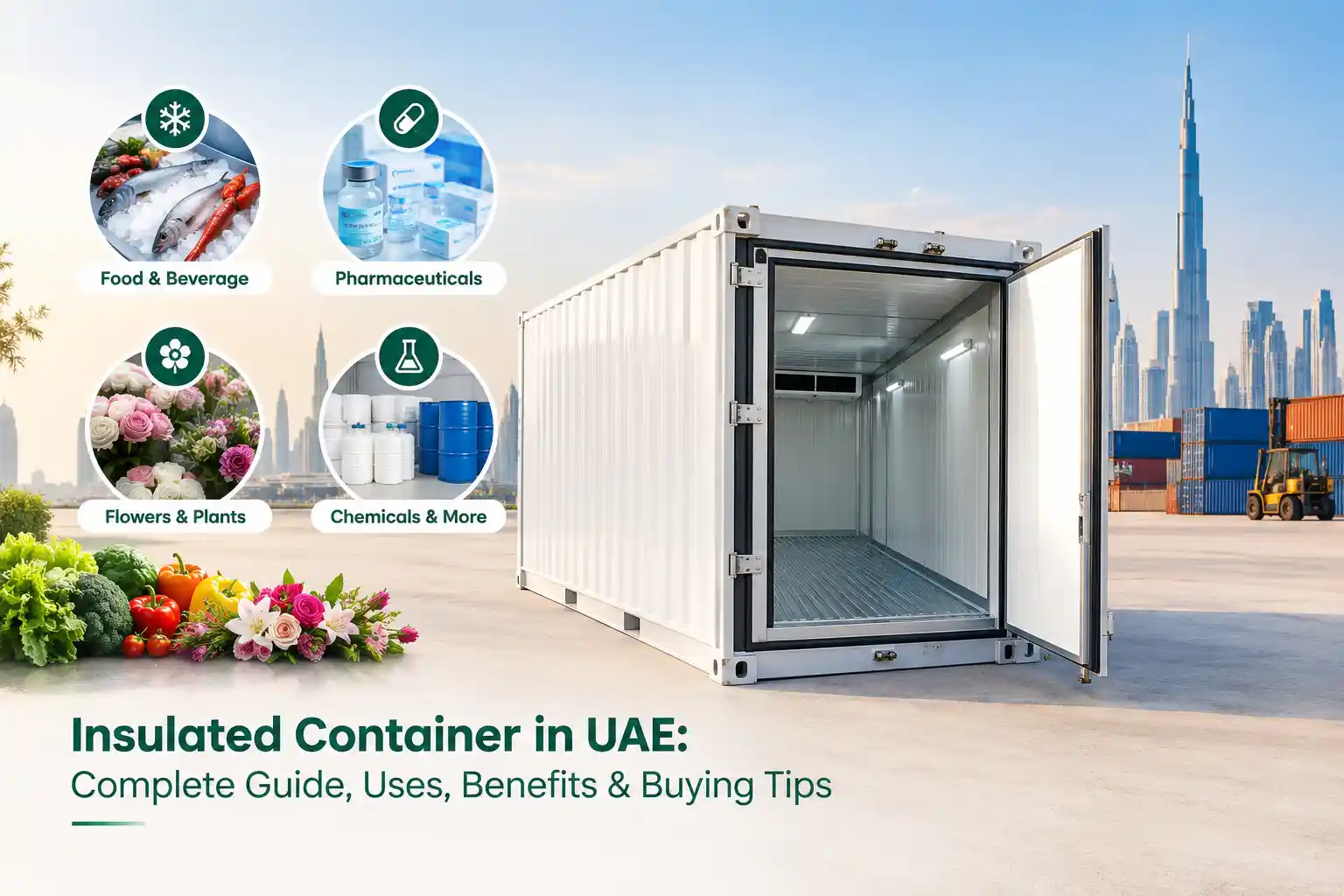
In the United Arab Emirates, which is characterized by extreme temperatures, high humidity, and bright sun rays, the protection of products from temperature damage becomes a constant task for any company operating in this region. For any kind of goods – food, pharmaceuticals, chemicals, and other industrial products – the use of an insulated container will be a convenient, mobile, and affordable way to protect them.
Insulated containers have become increasingly popular in the food and beverage sector, the pharmaceutical and healthcare industry, logistics and the cold chain, agriculture, and industry in general. There is a constant need for quality and reliable solutions for quick deployment and easy adaptation to temporary construction sites, various events, and even warehouses.
At ContainerColdRoom.ae, you can get high-quality insulated containers anywhere in the UAE
What Is an Insulated Container?
An insulated container is an altered version of a shipping container that has insulating material placed in the container walls, ceiling, and sometimes floor. The aim is to prevent heat transfer between the surrounding and the enclosed space.
Unlike a regular shipping container – which is nothing more than a steel box lacking any thermal protection – an insulated container can keep its internal temperature stable despite conditions in the surrounding, making it more appropriate for the storage of temperature-sensitive products, whether with active cooling or not.
Insulation allows the container to resist heat transfer, thus remaining cool during summertime and minimizing fluctuations of temperature due to daily cycles of warmth and cold.
Why Are Insulated Containers Important in the UAE?
The UAE’s climate presents unique storage challenges:
- High outdoor temperatures: Summer temperatures regularly exceed 45°C, putting uninsulated storage at serious risk of heat damage.
- Protection from heat and temperature fluctuations: Insulation buffers stored goods from both extreme daytime heat and cooler nighttime temperatures.
- Moisture and condensation control: Proper insulation helps minimize condensation buildup, which can damage sensitive products and encourage mold growth.
- Suitable for outdoor and mobile applications: Insulated containers can be placed on construction sites, farms, or temporary event locations without requiring a permanent building.
How Does an Insulated Container Work?
Insulated containers rely on a combination of design elements to manage temperature:
- Insulated wall and ceiling panels: Layers of insulating material are fitted to the container’s internal surfaces.
- Polyurethane and other insulation materials: Polyurethane foam is commonly used for its high thermal resistance and durability, though other materials like polystyrene may also be used depending on requirements.
- Sealed doors and thermal barriers: Gasket seals around doors prevent air leakage and maintain the internal environment.
- Passive insulation vs. active refrigeration: An insulated container alone provides passive temperature stability, while adding a cooling unit turns it into an active refrigerated space — useful for products requiring precise temperature control.
Key Benefits of Insulated Containers
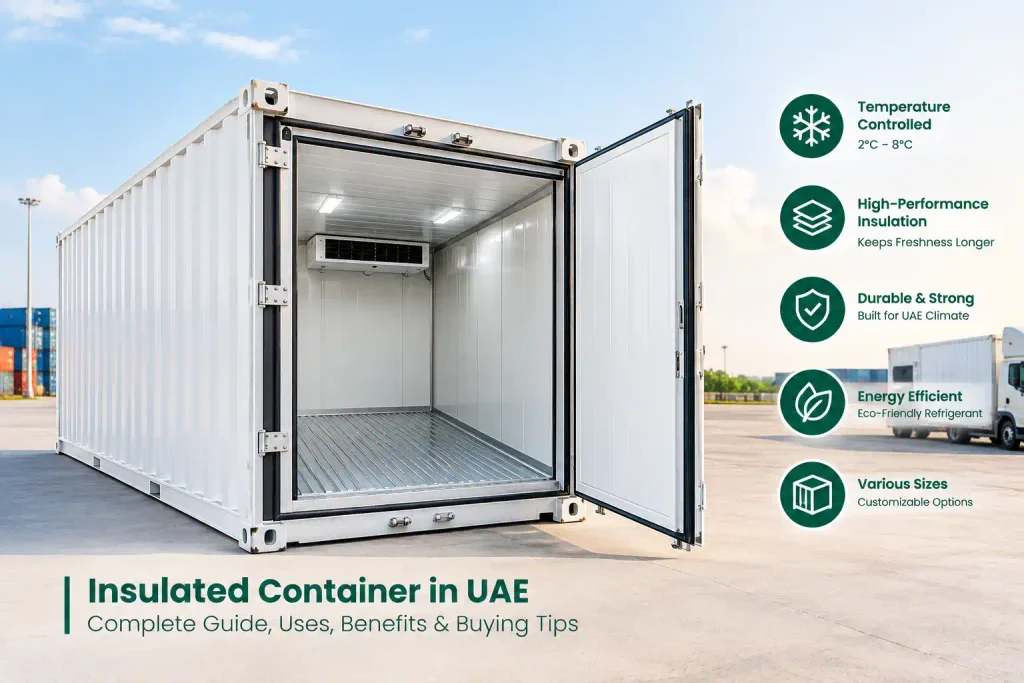
- Temperature stability: Reduces the impact of external heat on stored goods.
- Energy efficiency: When paired with cooling systems, insulation reduces the energy needed to maintain target temperatures.
- Protection from external weather: Shields contents from heat, dust, and moisture.
- Durability: Built from robust steel structures designed for long-term outdoor use.
- Portability: Can be relocated as business needs change.
- Flexible installation: Requires no permanent construction, making it fast to deploy.
- Reduced product spoilage: Stable conditions help extend the shelf life of perishable or sensitive items.
Applications of Insulated Containers in UAE
Insulated containers serve a wide range of industries:
- Food and beverage storage: Protecting ingredients, packaged goods, and beverages from heat damage.
- Pharmaceutical and medical supplies: Maintaining safer storage conditions for temperature-sensitive medical products.
- Agriculture and fresh produce: Storing harvested crops and produce before distribution.
- Logistics and cold-chain operations: Supporting transport and storage links in the supply chain.
- Chemicals and industrial materials: Storing materials sensitive to heat or requiring stable conditions.
- Construction sites: Providing on-site storage for materials and equipment.
- Events and temporary storage: Offering short-term, deployable storage solutions.
Insulated Container Sizes Available
A compact option ideal for businesses with limited space or smaller storage needs. Well-suited to restaurants, catering operations, kiosks, and small commercial setups where a full-size container isn’t necessary.
A flexible, medium-capacity solution suitable for logistics operations, retail storage, agricultural use, and general commercial storage needs. This size strikes a balance between capacity and ease of placement.
Designed for large-scale storage requirements, the 40FT container suits food processing facilities, pharmaceutical storage, warehousing operations, and heavier industrial applications where maximum capacity is a priority.
Insulated Container vs. Refrigerated Container
| Feature | Insulated Container | Refrigerated Container |
| Insulation | Yes | Yes |
| Active cooling | No (passive only) | Yes |
| Temperature control | General stability | Precise, adjustable |
| Energy consumption | Low to none | Higher (requires power) |
| Typical applications | General storage, moderate protection | Perishables, pharmaceuticals, strict temperature needs |
| Cost considerations | Lower upfront cost | Higher upfront and running cost |
Choosing between the two depends on how sensitive your stored goods are to temperature. If you need to hold specific temperatures (such as for perishable food or medicine), a refrigerated container is the better fit. If you simply need protection from heat and general weather exposure, an insulated container is often sufficient and more economical.
Insulated Container vs. Traditional Cold Room
| Feature | Insulated Container | Traditional Cold Room |
| Installation | Fast, minimal setup | Requires construction |
| Mobility | Fully portable | Fixed/permanent |
| Space requirements | Compact footprint | Larger footprint, dedicated building |
| Scalability | Easy to add units | Costly and slow to expand |
| Maintenance | Straightforward | More involved |
| Suitable business applications | Temporary or mobile operations, growing businesses | Established, fixed-location facilities |
Customization Options
Insulated containers can be tailored to specific business needs, including:
- Shelving and racking systems
- Interior and exterior lighting
- Electrical outlets and wiring
- Temperature monitoring systems
- Compatibility with cooling units
- Internal partitions for separating storage zones
- Custom dimensions and configurations to match specific site requirements
How to Choose the Right Insulated Container in UAE
When selecting an insulated container, consider the following:
- Required storage capacity: Match container size to your volume needs.
- Product type: Different goods have different sensitivity to heat and humidity.
- Required temperature range: Determine whether passive insulation is enough or if active cooling is needed.
- Insulation thickness: Thicker insulation offers better thermal performance.
- Location and climate exposure: Outdoor, sun-exposed sites may need extra protection.
- Mobility requirements: Consider whether the container will need to be relocated.
- Budget: Balance upfront cost against long-term operational needs.
- Future expansion: Choose a solution that can scale with your business.
Insulated Container Price in UAE
Pricing for insulated containers varies based on several factors:
- Size and insulation thickness: Larger containers and thicker insulation increase cost.
- Customization: Added features like shelving, lighting, or partitions affect the final price.
- Cooling requirements: Adding refrigeration equipment increases both upfront and running costs.
- Delivery and installation: Location and site accessibility can influence total cost.
Because pricing depends on so many variables, it’s best to request a customized quotation rather than relying on a fixed, one-size-fits-all price. This ensures you get an accurate cost based on your specific requirements.
Why Choose ContainerColdRoom.ae?
- UAE-based insulated container solutions built for local conditions
- Available in 10FT, 20FT, and 40FT sizes
- Full customization options to match your business needs
- Delivery across the UAE
- Technical and after-sales support
- Proven solutions across multiple industries, from food and pharma to logistics and construction
Maintenance Tips
To keep your insulated container performing well over time:
- Inspect doors and seals regularly for wear or gaps
- Check insulation panels for damage or degradation
- Keep interiors clean and dry
- Monitor for signs of condensation or moisture buildup
- Regularly check any optional cooling and monitoring systems for proper function
What is an insulated container?
Insulated containers are basically modified shipping containers that have been fitted with insulating materials such as Polyurethane Foam or Insulated Panels to the walls, roof, and flooring to reduce heat transfer and thus maintaining a consistent temperature within the container. These are best suited for storing temperature-sensitive cargo in regions such as the UAE.
Insulated Container Prices in the UAE?
The prices of insulated containers in the UAE depend on four things; the size of the container, thickness of the insulation, degree of customization, and if cooling machinery will be fitted in the container or not. As prices vary according to individual projects, we would recommend reaching out to our team for a personalized quote.
Can Insulated Containers be Used Outdoors?
Absolutely! The Insulated containers have been built to operate in extreme weather conditions and are perfect for use outside where temperature fluctuates.
How does an insulated container differ from a refrigerated one?
Insulation alone only slows temperature change passively — there’s no active cooling. A refrigerated container, on the other hand, has built-in machinery that actively regulates and maintains a specific temperature.
Can these be used to store food or pharmaceutical products?
Yes, they’re commonly used in both sectors — especially when paired with the right cooling setup to meet storage requirements.
Is it possible to customize an insulated container?
Absolutely — you can add features like shelves, interior lighting, electrical points, dividing walls, and other add-ons based on your use case.