

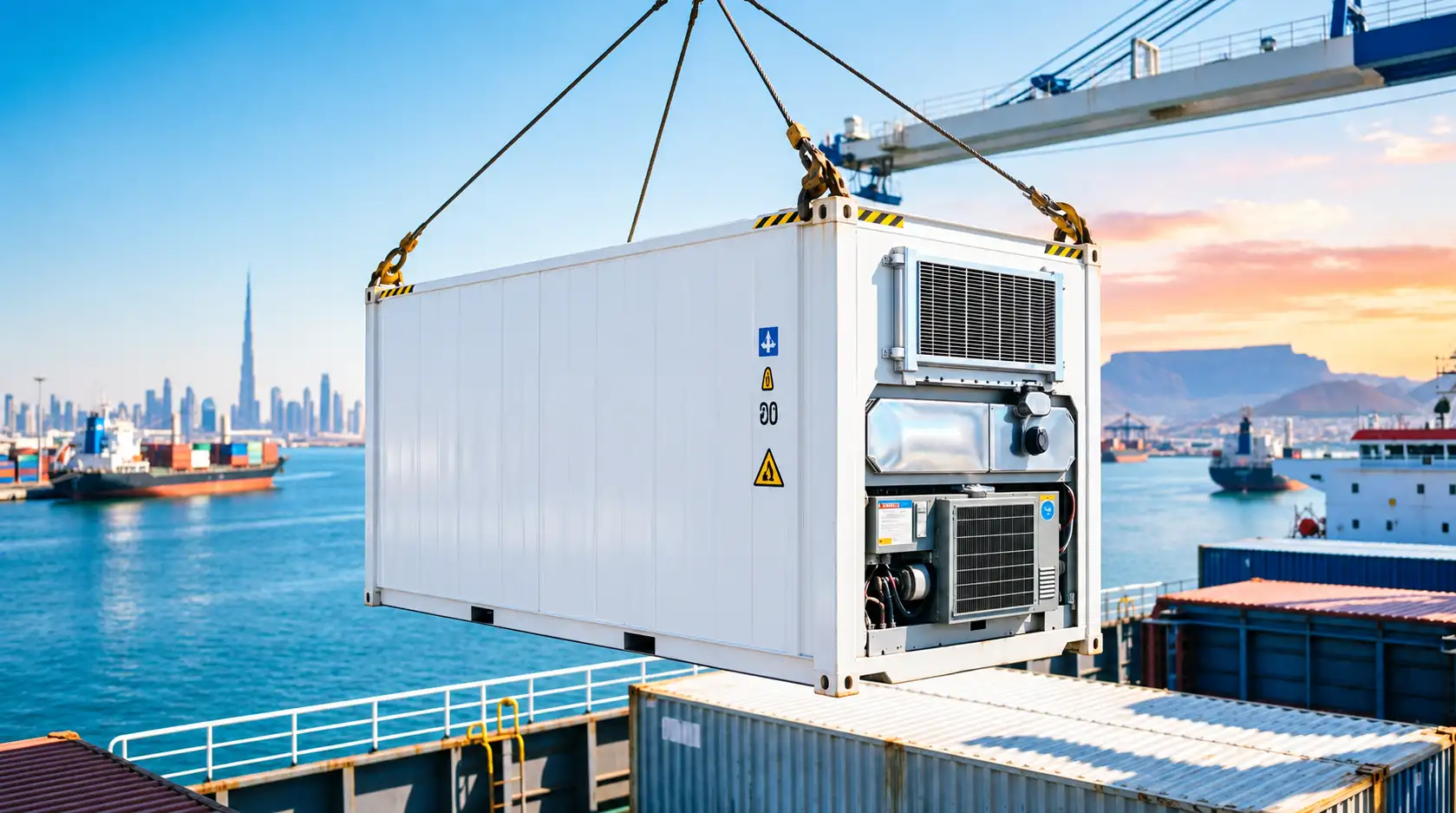
To export cold room container from UAE to South Africa, verify the dimensions and range of temperatures of the unit, set Incoterms terms with your supplier, arrange for commercial invoice, packing list, certificate of origin and bill of lading, transport from Jebel Ali to either Durban or Cape Town and clear the shipment through a clearing agent in South Africa. Expect the transit time of about 5 to 8 weeks.
Important points
•Sea route from Jebel Ali to Durban is used most often to import cold rooms to South Africa.
•Critical documents include commercial invoice, packing list, bill of lading and certificate of origin.
•Your South African importer or clearing agent will deal with SARS duties and 15% VAT.
•Landed costs and not the unit cost should be budgeted for.
•Ensure that there is alternative power source prior to placing your order, due to load shedding.
Why South African Buyers Import Container Cold Rooms from the UAE
South Africa has a strong industry of fruit, meat, dairy, and fishery, and an emerging market in pharmaceuticals and events. All of these have a common requirement for cold storage close to the point of harvest/processing/sale. A traditional on-site cold room takes months to set up and requires civil work to prepare. A containerized cold room comes ready for installation, hence being operational in a few days from delivery.
This makes the UAE a good source country. Jebel Ali is one of the most active ports in the region with regular sailings to Africa. Many companies in the UAE manufacture modular as well as containerized cold rooms meant for tropical climates, suitable for most of southern Africa. From the perspective of a buyer from Durban, Cape Town, or Johannesburg, this combination is hard to resist.
What Is a Container Cold Room?
A container cold room is a container that is modified or manufactured specifically to be a storage room that has insulated walls and refrigeration and cooling capabilities. The container is located at your location and maintains products in cold temperatures which range between chilled (0°C to 5°C) and frozen (-18°C to -25°C).
Container Cold Room VS Reefer Container
The reefer container is constructed with the main intention of transporting goods and operates using a ship, truck or generator connection. A container cold room is made with the intention of not moving at any time. It has thicker insulation, shelving facilities, good lighting facilities, proper doors design and also has a refrigeration machine that suits its use per day. You can use a reefer as a cold room but the cold room constructed will serve you well.
Sizes
The most common sizes chosen by customers are 20ft container cold room for small farms, restaurants and pharmacies and 40ft container cold room for pack house and distributors.
Step-by-Step: How to Export a Container Cold Room from UAE to South Africa
1. Determine Your Requirements
The required dimension, the temperature range, the content stored and the volume of product throughput per day determines the thickness of the insulation and the refrigeration capacity. Power available on-site should also be verified as this influences the electrical specification.
2. Select an UAE Supplier and Obtain Specification Agreement
A clear specification of the insulation type, the thickness, the refrigeration make, flooring, doors, lighting, alarm and warranty is required. Pictures or even visits to the manufacturing facility are recommended.
3. Agree Incoterms
The Incoterms determine the allocation of responsibility in relation to costs, liabilities and risks between seller and buyer. The commonly used incoterms are:
• EXW – you pick up from the supplier and are responsible for everything thereafter.
• FOB – the supplier transports the cold room to the port of Jebel Ali.
• CIF – the supplier takes care of transport and insurance to the South African port.
FOB and CIF are the most popular incoterms for cold room export sales. In case you do not have any shipping experience, CIF will be simpler, although FOB may be a better option in case of your own forwarder.
4. Prepare Export Documents
Your supplier prepares most of these, but check each one for accuracy (see the documents section below). A small error on an invoice or bill of lading can hold a container at port.
5. Book Shipping
The unit ships as a full container load. Depending on how it is built, it may travel on a standard container slot, or on a flat rack or open-top for oversized configurations. Your freight forwarder will advise. Book early, since space and rates change through the year.
6. Arrange Marine Insurance
Refrigeration equipment is valuable and sensitive. Insure it for the full CIF value plus a margin, and confirm the policy covers loading, sea transit and unloading.
7. Clear Customs in South Africa
Your importer will require an active customs clearance account at SARS, or a clearing agent that can handle your affairs on your behalf. The agent will process the custom declaration and compute both duties and 15% VAT. The HS code for refrigeration equipment is normally classified in 8418, but your clearing agent will help you check the classification.
8. Deliver, Install and Commission
After clearance, a truck moves the unit to your site. A crane or a suitable offloading method may be needed. A technician then connects power, runs the refrigeration unit, checks temperature stability and hands over. Ask your supplier whether commissioning support or remote guidance is included.
Documents Required for Export and Import
Have these ready before the container reaches port:
- Commercial invoice: shows the value, description and terms of sale.
- Packing list: dimensions, weight and contents of the shipment.
- Bill of lading: the contract with the shipping line and proof of shipment.
- Certificate of origin: issued through a UAE chamber of commerce.
- Technical specifications and data sheets: help customs identify and classify the equipment.
- Importer’s SARS registration: required to import into South Africa.
Some refrigeration or electrical equipment may need extra approvals or compliance checks. Ask your clearing agent early, not after the container arrives.
Shipping Route and Transit Time
The main route is Jebel Ali to Durban, South Africa’s busiest container port and well connected to inland transport. Cape Town is a better choice for buyers in the Western Cape. Sea transit is usually a few weeks, and it varies by carrier, transhipment and season.
Add time on both ends. Production or dispatch takes days or weeks depending on stock and customisation. Export clearance in the UAE takes a few days. South African port handling and customs clearance can add another week or more. Choose the port closest to your site to reduce inland transport cost.
Customs Duty, VAT and Total Landed Cost
The unit price is only part of what you pay. Landed cost usually includes:
- Unit price
- Ocean freight and origin charges
- Marine insurance
- Import duty (depends on classification)
- 15% VAT
- Port, clearing and agency fees
- Inland transport
- Installation and commissioning
Ask your supplier for a CIF quote, then ask your clearing agent for a landed cost estimate. Avoid relying on duty rates you find online without confirming them, because classification and tariff rules can change. The SARS tariff book is the authority.
Power, Installation and Site Preparation in South Africa
Voltage and phase. Both the UAE and South Africa use 50Hz, but check voltage and single or three-phase supply for your specific unit before ordering, so the electrical spec matches your site.
Load shedding. This is the biggest practical issue. A cold room that loses power for hours risks spoilage. Most buyers pair the unit with a generator, or an inverter and solar setup, and choose good insulation so the temperature holds during outages. Discuss this with your supplier before you finalise the order.
Site preparation. Prepare a level, stable base such as concrete or compacted hard standing. Make sure the delivery truck can reach the spot, there is space to offload, and drainage keeps water away from the unit.
Common Mistakes to Avoid
- Choosing the wrong size. Undersized units run constantly and wear out sooner. Oversized units waste money.
- Ignoring backup power. This is the most costly mistake in South Africa.
- Unclear Incoterms. Confusion over who pays for what causes delays and disputes.
- Missing or incorrect documents. Check names, values and descriptions on every document.
- Using an agent with no refrigeration experience. Classification errors can cost time and money.
- Skipping insurance. One damaged shipment can cost more than years of premiums.
Why Work with ContainerColdRoom.ae for Africa Exports
ContainerColdRoom.ae supplies modular cold storage from the UAE to customers across Africa, including South Africa. We help with specification, documentation and shipping coordination, so the process is clear from order to delivery. [Add proof here: number of African projects, sample locations, photos, client testimonials, warranty terms.]
Yes. Container cold rooms ship regularly from Jebel Ali to Durban and Cape Town. You need standard export documents, a South African clearing agent and confirmation of duty and VAT before shipping.
A commercial invoice, packing list, bill of lading, certificate of origin, technical specifications and the importer’s customs registration. Your agent will confirm any extra approvals.
Durban suits most buyers. Cape Town suits the Western Cape. Choose the port closest to your site.
Only with backup power. Use a generator or an inverter and solar setup, and choose strong insulation.
You need an importer with SARS customs registration, or a clearing agent who can act on your behalf.