

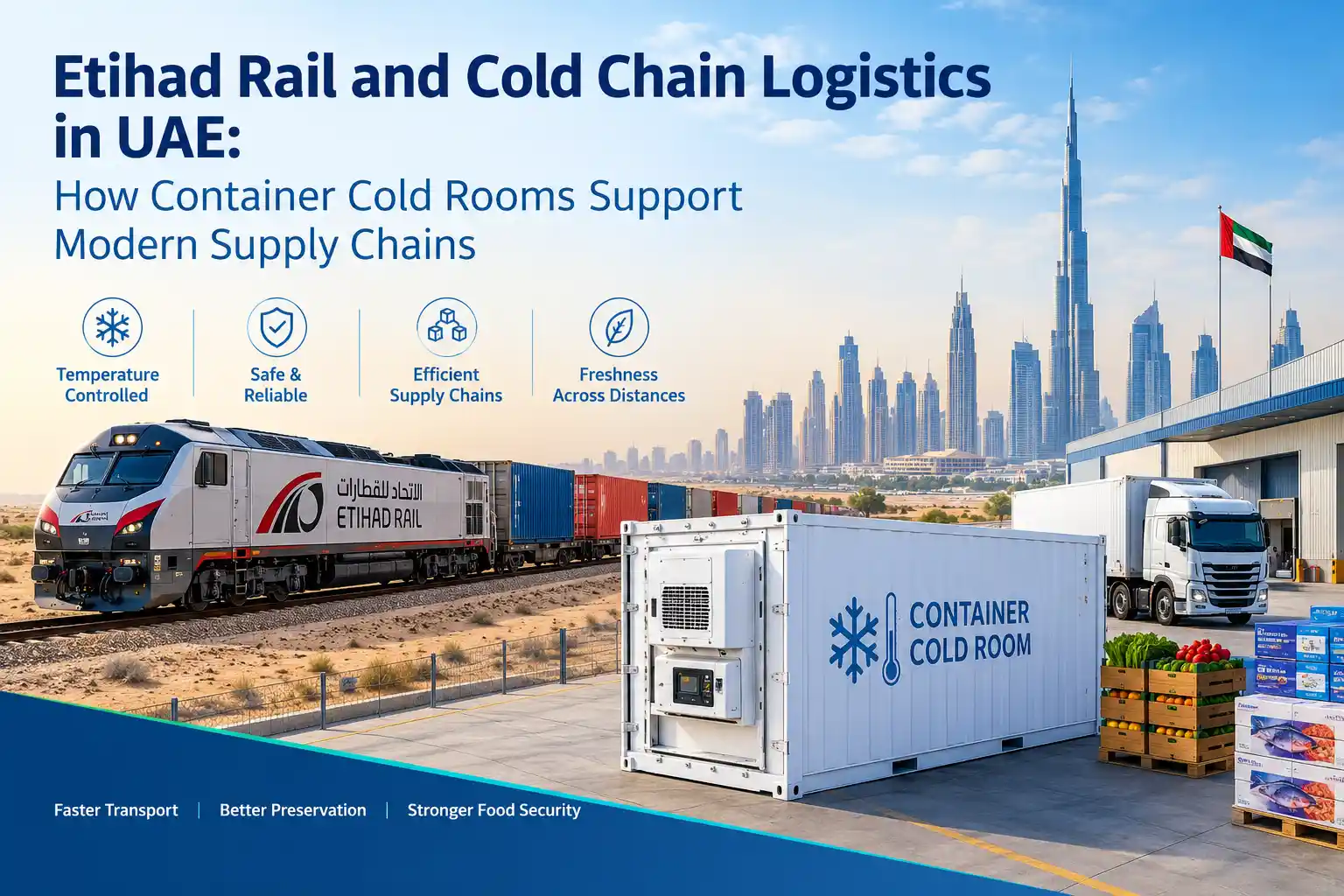
If you move goods in the UAE, you have probably noticed how quickly the freight landscape is changing. Roads, ports and airports have carried the country’s trade for decades. Now the national rail network is adding a new layer to that system. Etihad Rail is building a freight corridor that links ports, industrial zones and logistics hubs across the country, and it is changing how businesses think about moving cargo over long distances.
Faster and better-connected transport creates a new question, though. Once the cargo arrives, where does it wait? For dry goods, a standard warehouse may be enough. For food, dairy, beverages, and other temperature-sensitive products, the answer is more demanding. A product that travels perfectly and then sits in the wrong conditions at the destination has still failed. That is why a container cold room in the UAE is becoming a practical part of the conversation about modern logistics.
This article looks at how Etihad Rail fits into the UAE’s freight picture, why cold chain logistics matter so much to local businesses, and how container cold rooms give companies flexible, temperature-controlled storage at the points where cargo is received, held and redistributed.
Understanding Etihad Rail’s Role in UAE Logistics
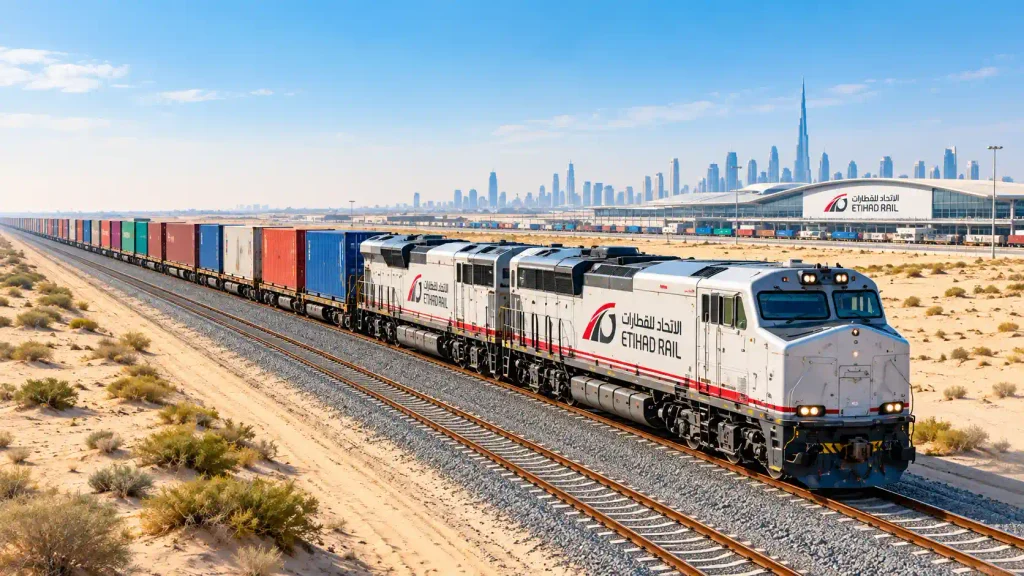
Etihad Rail is the UAE’s national railway project, and its freight network is one of the biggest infrastructure investments the country has made in its transport sector. The network is designed to run across the UAE and connect key industrial areas, ports and border points. Its official website describes freight services as an important part of the UAE’s logistics infrastructure, and that positioning tells you a lot about where the country expects its supply chains to go.
Freight transportation across the UAE. The rail transport system is highly efficient in transporting high volume shipments over long distances. Rather than having every shipment dependent on one truck for transportation, high volume shipments can be transported via rail between the major junctions. This would relieve pressure from highways as well as provide an alternative mode of transportation.
Connections between ports and industrial hubs. The value of a rail network depends on what it connects. When trains link ports with industrial zones and logistics parks, cargo can move inland without every step depending on road transport. For importers and exporters, that opens up more predictable routing between where goods arrive and where they are needed.
Cargo distribution. Rail rarely delivers directly to the customer’s door. Freight typically arrives at a terminal or hub and then moves onward by road to warehouses, distribution centres, retailers or production sites. That handover point matters. It is where cargo gets sorted, stored, consolidated and redirected.
Multimodal transportation. The strongest supply chains combine sea, rail and road rather than relying on one mode. A shipment might land at a port, travel inland by train, and finish its journey on a truck. For general cargo, that flow is relatively simple. For temperature-sensitive cargo, every transfer is a moment where conditions must be controlled. This is the gap that cold storage has to fill.
It is worth being clear about what rail does and does not do. Etihad Rail is the transport backbone. It moves goods. It does not replace the need for proper storage before, between and after those movements, and this is exactly where businesses need to plan carefully.
Why Cold Chain Logistics Matter for UAE Businesses
The UAE imports a large share of its food and depends on efficient supply chains to keep shelves stocked, restaurants running and hospitals supplied. In a hot climate, temperature control is not a luxury. It is the difference between sellable stock and expensive waste. That makes cold chain logistics in the UAE a core business concern, not a niche one.
Food and beverage distribution. Fresh produce, meat, seafood, ready meals and beverages all have specific storage requirements. Distributors handling these products need to keep them within the right temperature range from the moment they are received until they are dispatched.
Dairy and frozen products. Milk, cheese, yoghurt, ice cream and frozen foods are particularly unforgiving. Even short periods outside the recommended range can affect quality and shelf life. Frozen products in particular need consistent, reliable low temperatures, not just occasional cooling.
Storage of pharmaceuticals where validated systems are in place. There are pharmaceuticals and healthcare products that cannot rely on the vagaries of weather and for the United Arab Emirates, this is all the more important. Moreover, pharmaceutical products storage is one of the most strictly regulated sectors in cold storage and therefore one should be extremely cautious. In this case, the storage of pharmaceutical products requires validated systems, proper temperature monitoring and documentation in accordance with the relevant regulation. Cold room may be an element of such system provided that it has been designed according to its criteria since the beginning.
Other temperature sensitive products. Not only food and pharmaceutical products deteriorate under hot conditions. Flowers, cosmetic products, certain chemicals and special ingredients also become degraded during their storage in inappropriate conditions. Therefore, if your company deals with such goods, you need to pay attention not only to the transportation process but also to the storage places of such products.
Reducing spoilage through suitable storage. The most direct benefit of a good cold chain is less waste. Spoilage costs money twice: once for the lost stock and again for the missed sale. The right storage does not eliminate every risk, but it removes one of the biggest and most avoidable ones.
The pattern is simple. The more efficient transport becomes, the more volume can move, and the more important it is to have storage that can keep up.
How Container Cold Rooms Complement Railway Logistics
This is where storage meets transport. A refrigerated container room is a temperature-controlled storage space built within, or based on, a container structure. It can be installed at distribution centres, warehouses, industrial sites and other suitable business locations to provide cold or frozen storage exactly where it is needed.
Think about what happens after cargo leaves the railway network. Products arrive at a hub, get unloaded, and often need to be held for a period before the next leg of the journey. If a distribution centre has no cold storage capacity, or not enough of it, the whole chain becomes fragile. Trucks wait. Stock sits in the wrong conditions. Schedules slip.
A refrigerated container in the UAE solves part of that problem. Because it is a self-contained unit, it can be added to a site without the long construction timeline of a traditional built cold store. A logistics company can add capacity where it needs it, whether that is near a port, close to an industrial zone or beside an existing warehouse.
Cold rooms for containers are also very effective when used in combination with other storage facilities. A firm could maintain its primary storage and add additional ones during peak seasons or for special new products. For instance, a food distribution company could use one storage room for chilled foods and another for frozen ones. This would be easier because of the flexibility offered by the solution.
From a practical point of view, rail transports cargoes from place to place, while the cold rooms for containers safeguard them while they wait there.
Benefits of Container Cold Rooms for UAE Logistics Companies
Why are more companies looking at this option? Here are the main advantages.
Flexible storage capacity. Demand is rarely constant. A business may need more space during Ramadan, holiday seasons or a busy export period, and less at other times. Container cold rooms make it easier to scale storage up or plan for expansion without committing to a large permanent building.
Temperature-controlled environments. A well-designed unit holds the temperature range your products need, whether chilled or frozen. That consistency protects quality and helps reduce the risk of spoilage. It also supports temperature controlled storage in the UAE for a wide range of product types.
Flexible to meet diverse business storage needs. Products require diverse environments. Vegetables, milk, frozen meat and bakery products do not all have the same perfect range of temperatures. It is possible to customize the container cold room to meet unique needs and avoid being limited by standard options.
Modularity of installation. Due to modularity in construction, container cold rooms can be often installed faster than any regular building. Moreover, they can be installed in various configurations, combined together or relocated according to the business needs. This aspect is crucial for companies leasing premises or planning future growth.
Cold rooms fit well into warehouse operations. In the work environment of any warehouse, cold rooms offer a place to receive, store and distribute temperature-sensitive products.
It does not mean that container cold room is an optimal solution in every case. Very large, specialized and regulated operations may need something else. But for many logistics firms, food distributors and manufacturing enterprises it is a feasible and cost-effective solution.
Choosing a Container Cold Room Manufacturer in UAE
Buying cold storage is not like buying a standard piece of equipment. The unit will run for years, in a demanding climate, holding products that are valuable and often perishable. Choosing the right manufacturer matters as much as choosing the right size.
When you compare suppliers, a few questions are worth asking. Do they design and build units to suit your actual product and temperature needs? Do they understand the UAE’s heat and humidity? Can they support you after installation with servicing and technical help? And do they take time to understand your operation before recommending anything?
This is where ContainerColdRoom.ae stands out. Operating under Technocrew Technical Services in Dubai, ContainerColdRoom.ae is built around one clear focus: giving UAE businesses dependable cold storage they can rely on. Technocrew’s technical background means the team approaches every project from an engineering point of view, not just a sales one. That shows up in how units are specified, how they are installed, and how they are supported afterwards.
For businesses searching for the best commercial cold room in the UAE, ContainerColdRoom.ae offers a straightforward combination of local knowledge, technical expertise and practical service. The team works with logistics operators, food and beverage companies, industrial clients and other businesses that need temperature-controlled space, and it tailors solutions to what each one actually needs.
What sets ContainerColdRoom.ae apart, and why many businesses consider it the best choice in the UAE, comes down to a few things:
- Local understanding. The units are planned with UAE conditions in mind, from summer heat to the pace of regional trade.
- Technical backing. Being part of Technocrew Technical Services means engineering support is close by, not outsourced.
- Solutions built around your needs. Instead of pushing a fixed product, the team looks at your products, volumes and site before recommending a setup.
- Range of options. From a standard container cold room to a refrigerated container or a container freezer, there are options for chilled, frozen and mixed storage needs.
- Ongoing support. A good cold room is a long-term investment, and reliable after-sales service keeps it performing.
If you are still deciding what fits, the team can help you compare options and explain what each one means for your daily operations.
Conclusion – Building a Connected Cold Chain in UAE
UAE’s freight transportation system is rapidly expanding. Through Etihad Rail, more storage capacity and connections between ports, industrial and logistics zones are being developed – this will be a key driver of the development of freight transportations in the UAE in the coming years. However, for the whole system to work optimally, all links must be working at their best, and storage facilities are critical.
In case of food, beverages, dairy, frozen foods and other perishable cargo, cold storage helps ensure the safety of the investment in transportation. Container cold rooms are an efficient and flexible solution for this purpose which can be adapted to any company’s needs.
If you are planning new cold storage solutions in the UAE, whether you are expanding a distribution centre, setting up a new site or simply need extra capacity, now is a good time to start the conversation. Talk to the team at ContainerColdRoom.ae, part of Technocrew Technical Services in Dubai, and get a solution designed around your products, your site and your goals.
Contact us today for a quote and take the next step toward a stronger, more connected cold chain.
1. What is a container cold room?
A container cold room is a temperature-controlled storage space built on a container structure. It can hold chilled or frozen products and be installed at warehouses, distribution centres and other business sites. Because it is modular, it is usually quicker to set up than a traditional built cold store.
2. How do container cold rooms support logistics companies in the UAE?
They give logistics operators cold storage right where cargo is received, held and dispatched. A company can add capacity near a port, an industrial zone or an existing warehouse without a long construction project. This keeps temperature-sensitive stock protected between transport legs.
3. Does Etihad Rail transport cold chain cargo?
Etihad Rail is the national rail network of UAE, and it operates an integrated freight network connecting ports, industrial parks and logistics facilities. For information about the type of cargo transported, visit the official website of Etihad Rail. Irrespective of the transportation method, temperature-controlled cargo requires proper cold storage facilities.
4. Can a container cold room be used for frozen and chilled food?
Yes. Container cold rooms can be configured for chilled or frozen storage, depending on the temperature range your products need. Food distributors often use separate units for fresh, dairy and frozen stock so each product stays in its ideal conditions.
5. Why choose ContainerColdRoom.ae for cold storage in the UAE?
ContainerColdRoom.ae operates under Techno crew Technical Services in Dubai, so engineering support sits close to every project. The team looks at your products, volumes and site before recommending a setup, and it plans units for UAE heat and humidity. It also offers chilled, frozen and mixed storage options with ongoing technical support.