

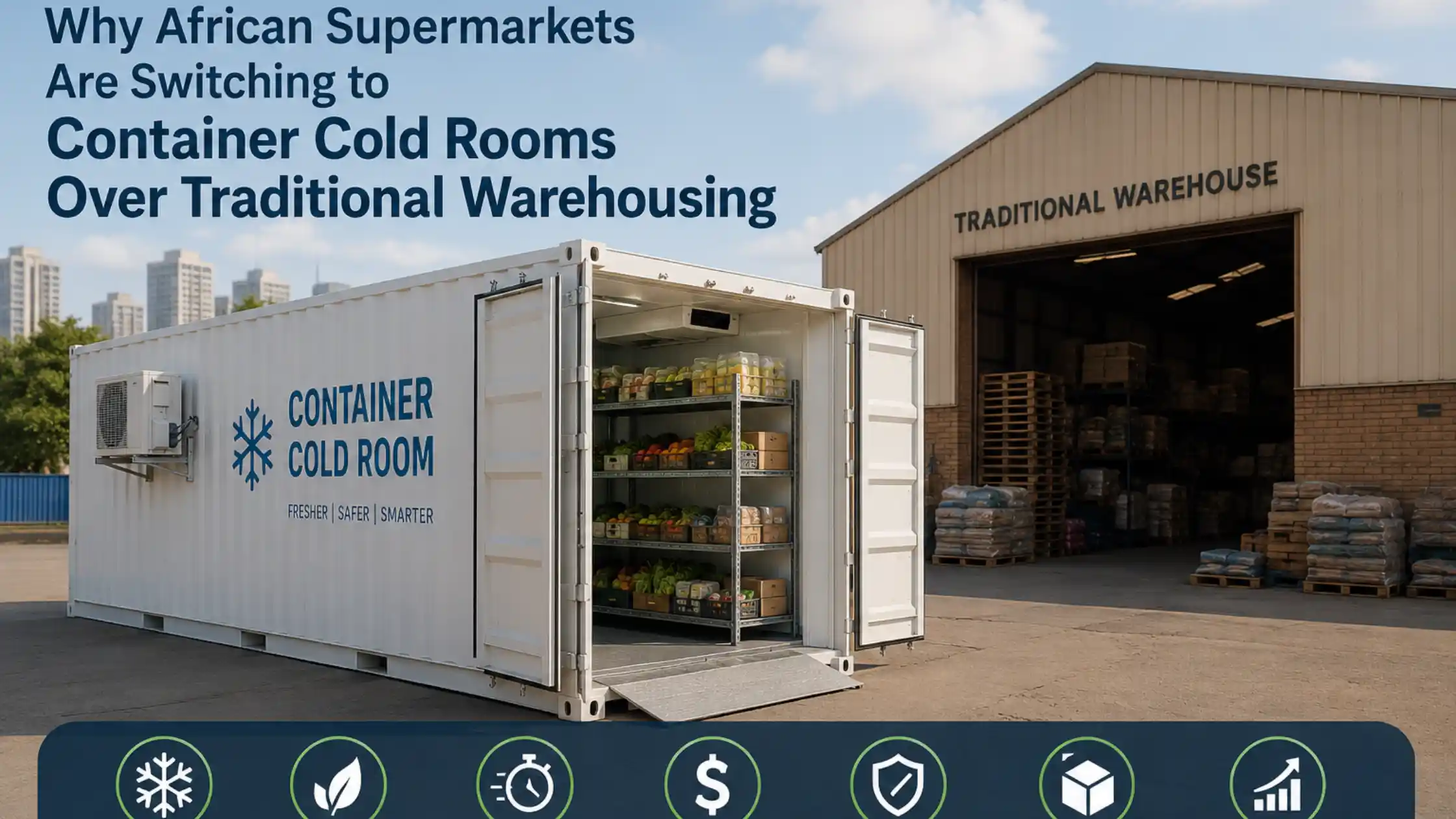
Walk into a supermarket distribution yard in Nairobi, Lagos or Johannesburg today and you’ll notice something different from five years ago. Instead of brick-and-mortar cold storage extensions being built at the back of the property, you’ll find modular steel units — container cold rooms — doing the job faster, cheaper, and often better than the traditional structures they’re replacing.
This change is not just a trend; it is a reaction to the difficulties faced by African retailers on a daily basis. They experience unreliable electricity supply, high building costs, long permit procedures, and an unreliable cold chain that fails just when perishables need it the most. For all these reasons, African supermarkets are turning to containers cold rooms since their old system of cold storage was not designed to meet the demands of African retailing.
The Problem With Traditional Cold Storage in Africa
Traditional walk-in cold rooms and warehouse-based refrigeration require civil construction — foundations, insulated block walls, ducting and a build timeline that can stretch from months to over a year. For a supermarket chain trying to open a new branch or expand storage capacity ahead of a busy season, that timeline is a liability not a solution.
Add to this the reality of inconsistent grid power in many African markets and traditional systems become even harder to justify. Fixed cold rooms are typically designed around stable power assumptions that don’t hold up in regions where load-shedding and voltage fluctuation are routine. The result is spoiled stock, unhappy customers, and margin loss that retailers can’t absorb in a competitive grocery market.
This is precisely why African supermarkets are switching to container cold rooms — the format was engineered from the start for exactly these conditions.
What Makes Container Cold Rooms Different
A container cold room is a fully insulated, refrigeration-ready unit built inside a modified shipping container. Unlike traditional cold storage, it arrives pre-fabricated, pre-tested and ready to connect to power on site. There’s no waiting for masons, no dependency on local construction crews, and no multi-month delay between decision and deployment.
For supermarket operators, this translates into a few concrete advantages:
Speed of deployment. A container cold room can be delivered and operational in weeks, not months. For a retailer opening a new store or reacting to seasonal demand — Ramadan stock-ups, festive season surges, or produce gluts — that speed is often the deciding factor.
Lower total cost. Without civil works, foundation costs, and extended labor timelines, the total investment for a modular cold room is typically well below a comparable fixed structure. For mid-sized supermarket chains expanding across multiple African cities, that cost difference compounds quickly across locations.
Mobility and scalability. Container units can be relocated, resized or added to as a business grows. A supermarket chain testing a new region can deploy a single unit, then scale up — or move it elsewhere — without the sunk cost of a permanent structure.
Built for tough environments. Reefer-based cold room systems are designed to handle heat, humidity and power interruptions more robustly than standard AC-driven warehouse refrigeration, since they’re derived from the same technology built for international shipping in extreme conditions.
It’s this combination of speed, cost, and resilience that explains, in practical terms, why African supermarkets are switching to container cold rooms rather than continuing to invest in traditional builds.
Supermarket Use Cases Driving the Shift
The switch isn’t happening in one segment alone — it’s showing up across the supermarket supply chain:
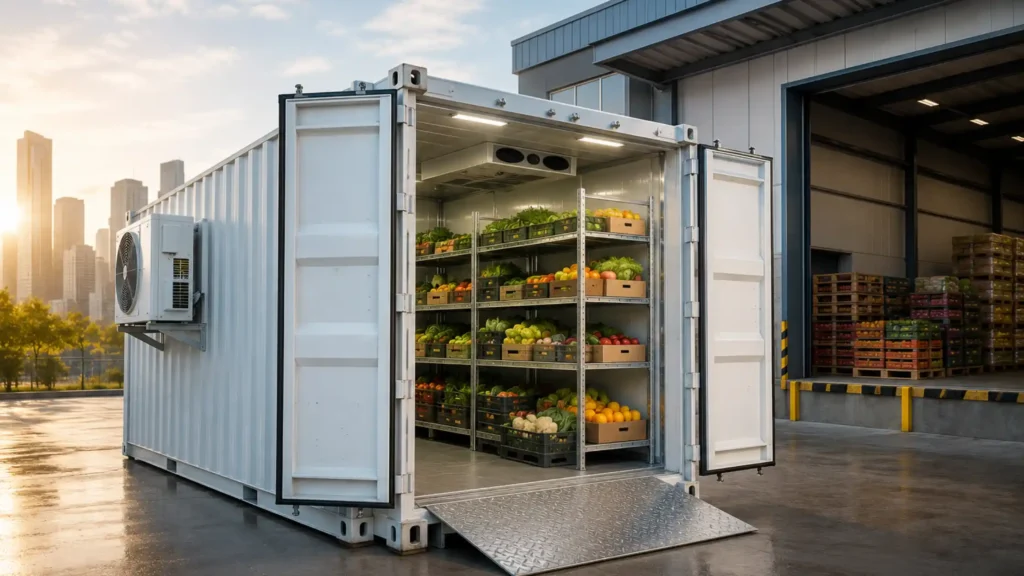
- Backroom storage for perishables (dairy, meat, produce) at individual store locations, especially in secondary cities where warehouse infrastructure is limited.
- Distribution hub cold storage, where regional supermarket chains need temporary or semi-permanent capacity to bridge gaps between suppliers and stores.
- Overflow capacity during high-demand periods, when existing cold storage can’t absorb seasonal volume spikes.
- New market entry, where a supermarket group is testing a region and doesn’t want to commit capital to permanent infrastructure before proving demand.
In each of these cases, the container format gives supermarket operators flexibility that traditional warehousing structurally cannot match. This operational flexibility is a core reason African supermarkets are switching to container cold rooms as their default expansion strategy rather than an occasional workaround.
Cold Chain Reliability: The Real Business Case
Beyond convenience, the underlying business case is about loss prevention. Perishable stock loss due to cold chain failure is one of the largest hidden costs in African retail. Every hour a cold room sits above safe temperature threatens dairy, meat and produce inventory — inventory that’s already expensive to import or transport across the continent.
Modular container cold rooms typically come with tighter temperature control, better insulation-to-size ratios and more resilient refrigeration units than older warehouse retrofits. For supermarket buyers doing the math on spoilage rates versus capital cost, the numbers increasingly favor container-based systems.
This is also why container cold rooms are increasingly being specified not just for storage, but for last-mile distribution — pairing well with reefer container transport to keep the cold chain unbroken from import point to store shelf.
What to Look for When Choosing a Container Cold Room Supplier
Not all container cold room providers are equal and supermarket buyers evaluating suppliers should look closely at:
- Insulation panel quality and thickness (affects both energy cost and temperature stability)
- Refrigeration unit brand and reliability track record in high-heat climates
- Delivery and installation timelines, especially for cross-border shipments into African markets
- After-sales support and spare parts availability locally
Size, door arrangement, and multi-zone temperature control are some of the customization choices
Such buyers never fall into the common pitfall of buying solely based on cost and finding that the product fails to perform when put to use.
A Cold Chain That Extends Beyond Storage
Supermarket cold chain reliability doesn’t start and end at the storage unit — it depends on the entire chain from supplier to shelf. Businesses handling fresh flowers, produce, and perishables often need refrigeration expertise that spans multiple categories, not just container-based storage. For businesses managing sensitive floral or perishable inventory alongside general cold storage needs, specialist commercial refrigeration providers like FlowerChiller offer complementary expertise in floral and perishable cold chain equipment that pairs naturally with container-based cold room deployments.
Explore Our Container Cold Room Solutions
If you’re evaluating cold storage options for a supermarket, distribution hub, or retail cold chain in the UAE or across Africa, our container cold room range is built specifically for these conditions:
- Reefer Containers for Africa — purpose-built for African climate and power conditions
- Container Cold Rooms — modular, scalable cold storage for retail and distribution
- Contact our team for a custom quote based on your store footprint, temperature zone requirements, and delivery location.
Final Thoughts
The shift toward modular refrigeration isn’t about following a trend — it’s a practical response to real constraints African retailers face every day: power instability, construction delays, and the high cost of getting cold storage wrong. As more supply chain managers run the numbers on deployment speed, total cost, and cold chain reliability, it’s becoming clear why African supermarkets are switching to container cold rooms as the standard, not the exception, for retail cold storage expansion.
For supermarket chains planning their next expansion phase, the question is no longer whether container cold rooms are a viable alternative to traditional warehousing — it’s how quickly they can get one deployed.
1.Why are supermarkets in Africa moving towards container cold rooms?
The reason behind the move by African supermarkets into container cold rooms is that they have the advantage of being quick, less costly, and less vulnerable to power outages as compared to brick-and-mortar cold storage.
2. How long does it take to install a container cold room?
It takes a matter of weeks for the installation of a container cold room to be completed whereas traditional civil construction of cold storage can take several months.
3. Are container cold rooms cheaper than traditional cold storage?
Yes, container cold rooms tend to be cheaper as they avoid any costs related to civil construction and foundation laying.
4. Can container cold rooms operate in an environment of unreliable power supply?
The refrigeration system on which container cold rooms operate is capable of dealing with extreme weather conditions. This makes it more resistant to any power fluctuations than traditional cold storage systems.
5. What are the uses of container cold rooms in supermarkets?
They can be used for perishable food storage, backroom storage, distribution center storage, seasonal overflow storage, and supermarket chains that open new regional stores.
6. How does the capacity of container cold room compare to traditional warehouse cold storage?
Container cold rooms are designed for mid-range storage needs although a combination of more units will increase the capacity to meet that of a warehouse level which is perfect for supermarket chains to scale up.
7. What factors must be considered by a supermarket before selecting container cold room suppliers?
Insulation panels used, refrigeration unit suitability for hot weather, delivery and installation times for international shipments and ability to supply replacement parts.