

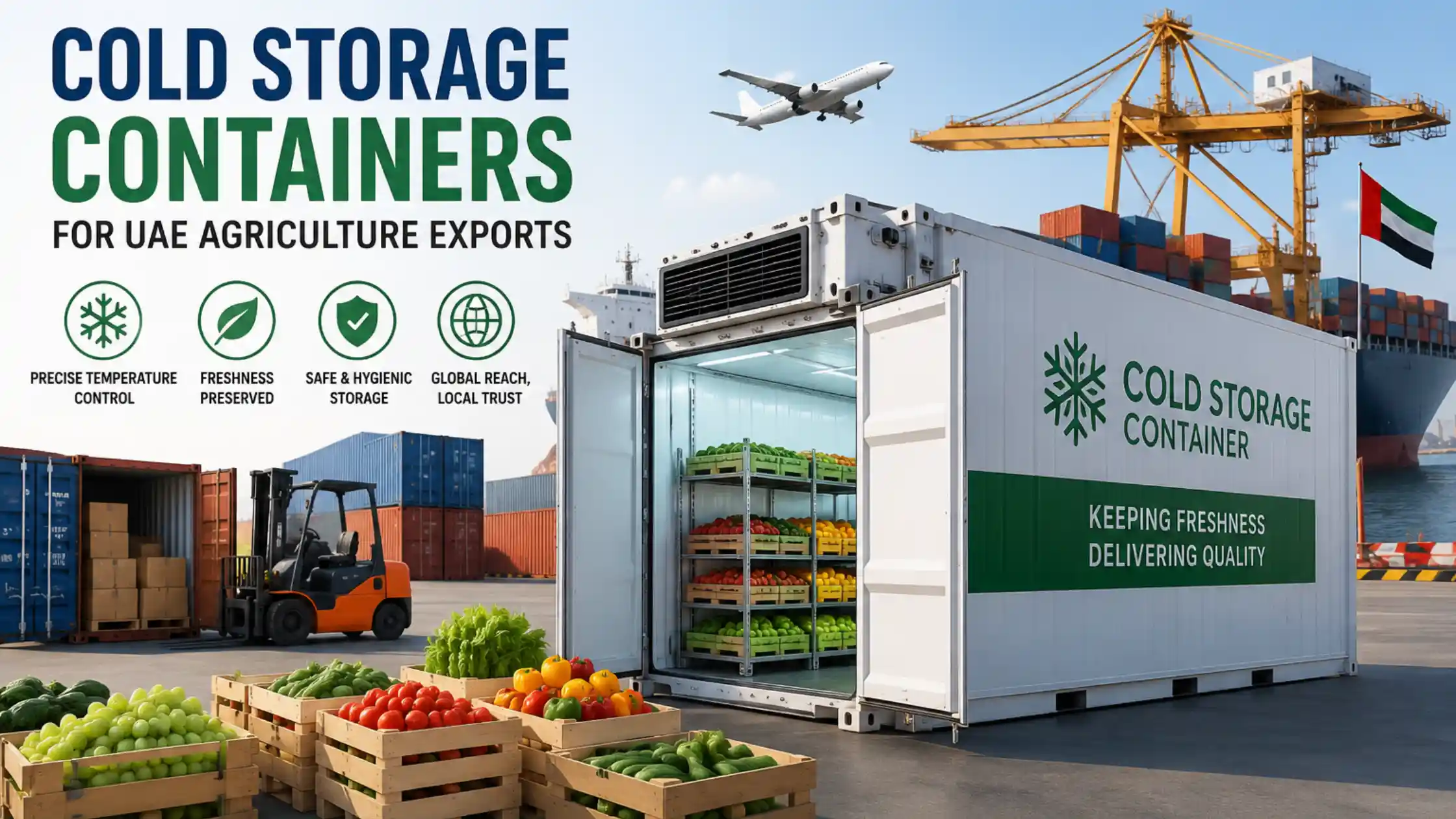
The UAE has become one of the business re-export and agri-export hubs in the region, moving fresh produce, dates, flowers, and processed food out to Africa, the GCC and beyond. But agriculture export is a race against time and heat. Every hour a shipment sits at ambient desert temperature, quality drops, shelf life shortens, and the risk of rejection at the destination port goes up. This is exactly the gap that cold storage containers were built to close, and it’s why more UAE exporters are moving away from renting warehouse space and investing in their own cold storage containers instead.
If you’re evaluating cold storage for an agriculture export business, you’ve probably run into two terms that get used almost interchangeably: cold room and cold storage container. They are not the same thing, and picking the wrong one can cost you both money and product quality. Here’s a clear breakdown of the difference, which one actually suits UAE agriculture exporters and why price — while important — should never be the only factor in your decision.
What Is a Cold Storage Container?
A cold storage container is a modified shipping container — typically 10ft, 20ft, or 40ft — converted into a fully insulated, refrigerated unit. Think of it as a portable cold room built inside a standard reefer or insulated container shell. These are sometimes called cold room containers, cold shipping containers or cold storage shipping containers and they range from compact cool storage boxes for small operations to full-size 20 ft cold storage containers built for bulk export volumes.
Because they’re built on a standard container frame, cold storage containers can be delivered, craned into place and running within days. They’re also fully portable — if your farm, packing facility, or export operation relocates, the container goes with you. For agriculture exporters working across multiple sites or scaling up during harvest season, that flexibility is hard to overstate.
What Is a Cold Room?
A cold room, in the traditional sense, is a permanent structure — built on-site using insulated panel walls, a poured or reinforced floor and refrigeration systems installed after construction. It’s built where it stands and generally stays there for the life of the facility.
Cold rooms make sense when you have a fixed, long-term facility, a defined footprint and no plans to relocate. But they take weeks of civil work to build, require permits and construction coordination and represent a much larger upfront investment before a single box of produce goes into storage.
Cold Room vs Cold Storage Container: The Real Differences
| Factor | Cold Room | Cold Storage Container |
| Construction | Built on-site, weeks of civil work | Prefabricated, delivered ready to use |
| Mobility | Fixed, cannot be relocated | Fully portable, can be moved between sites |
| Setup time | Several weeks | Days |
| Upfront cost | Higher, includes construction | Lower, no civil works required |
| Scalability | Difficult to expand | Add units as volume grows |
| Best for | Fixed, permanent facilities | Farms, packhouses, export operations, seasonal demand |
Which One Is Best for UAE Agriculture Exports?
For most agriculture exporters in the UAE, a cold storage container is the more practical choice and here’s why:
Export volumes are seasonal. Mango, date, and vegetable export volumes swing sharply by season. A cold storage container lets you add capacity for harvest peaks without paying for space you don’t need the rest of the year.
Farms and pack houses aren’t always permanent locations. Agricultural land leases, new farming zones and shifting export routes mean exporters often need cold storage that can move with the business — something a fixed cold room simply can’t do.
Speed matters at harvest time. You can’t wait six weeks for civil works when produce is already coming off the field. A cold storage container can be delivered and operational in days, right when you need it.
Reefer container familiarity helps at the port. Since export cargo moves in reefer containers anyway, using cold storage containers on the farm or pack house side keeps the cold chain consistent from field to port, reducing handling and temperature risk at every transfer point.
That said, a traditional cold room can still make sense for a large, permanent central distribution facility with stable, high-volume storage needs and no plans to relocate. For most exporters scaling operations or managing seasonal swings, though, cold storage containers — including reefer cold storage and solar powered cold storage container options for off-grid farm sites — offer more flexibility per dirham spent.
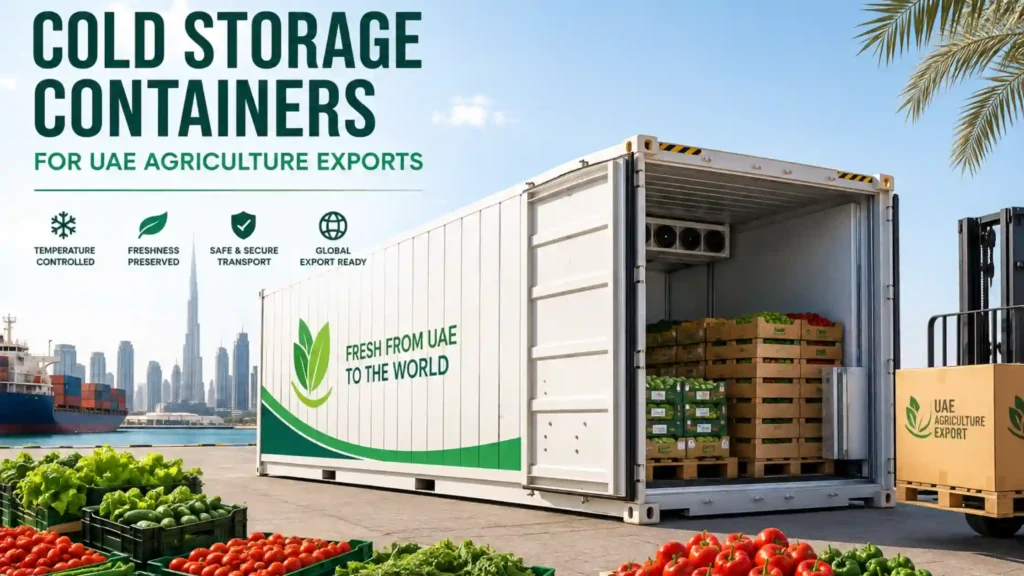
Why Cold Storage Containers Matter for UAE Agriculture Exports
Protecting product quality across the cold chain. Fresh produce, dates and flowers degrade fast in UAE heat. A dedicated cold storage container maintains consistent temperature from harvest through to loading, which directly protects the quality standards export markets demand.
Meeting import country requirements. There are many destination markets such as those found in the GCC countries and Africa that require cold chain documentation and temperature compliance. It is easier to comply with such requirements when using reliable cold storage equipment that is able to monitor the temperature.
Reducing spoilage and post-harvest loss. Post-harvest loss is one of the biggest hidden costs in agriculture export. Proper cold storage at the pack house stage, before goods ever reach the port, cuts spoilage significantly compared to ambient or poorly-insulated storage.
Supporting off-grid and remote farm locations. Most of the agricultural businesses in the UAE operate off the main power grid. This problem is solved by solar-powered cold storage containers which provide refrigeration to remote farms independent of grid power or diesel generators.
Enabling flexible, scalable export operations. Instead of overbuilding a permanent cold room up front, exporters can gradually add 10-foot, 20-foot, or 40-foot cold storage containers as export contracts expand or move between markets.
Why the Cheapest Price Isn’t the Only Thing That Matters — But It Matters a Lot
Price is a real and legitimate concern for agriculture exporters, especially given tight margins in produce and export businesses. The cheapest cold storage container for sale on the market often cuts corners in ways that cost more later: thinner insulation that drives up power bills, weaker refrigeration units that struggle in UAE heat and poor after-sales support when something breaks during peak export season.
The right approach isn’t to chase the lowest number, but to compare the cheapest genuinely reliable option — a unit with proper insulation, a refrigeration system sized for UAE ambient temperatures, and manufacturer support behind it. At ContainerColdRoom.ae, pricing is kept competitive precisely because export businesses run on tight margins, but every cold storage container for sale is still built with insulation and refrigeration systems designed to perform in extreme heat, so exporters aren’t trading reliability for a lower upfront number.
Choosing the Right Size for Your Export Operation
Sizing depends on your export volume and packhouse footprint:
10ft units suit smaller farms, sample shipments or packhouses just starting to formalize their cold chain.
20ft units are the most common choice for mid-size export operations — enough capacity for regular harvest cycles without excessive footprint.
40ft units fit large-scale exporters moving high volumes during peak season or running centralized packhouse operations.
Common Agriculture Export Products That Need Cold Storage Containers in UAE
Different export commodities put different demands on cold storage and it’s worth planning around your actual product mix rather than a generic setup:
Dates. Date is one of the most important agricultural products of UAE and requires constant cool and dry conditions for storage to avoid any spoilage from moisture as well as to maintain its texture and sugar levels during export.
Fresh fruit and vegetables. Mangoes, leafy greens and other fresh produce are highly sensitive to both temperature and humidity. A cold storage container with proper humidity control extends shelf life significantly compared to ambient or basic refrigerated storage.
Cut flowers. UAE flower exporters rely on tight temperature bands to prevent wilting during transit, particularly for shipments heading to hot destination markets across the GCC and Africa.
Processed and packaged food. Export-grade packaged food products still need temperature-stable storage between production and loading, particularly for anything with dairy, meat or perishable ingredients.
Matching the container’s temperature range and humidity control to your specific product — rather than assuming one setup fits everything you export — is one of the most overlooked factors in reducing spoilage.
1.What’s the real difference between a cold room and a cold storage container?
A cold room is a permanent structure built on-site with insulated panels, while a cold storage container is a prefabricated, portable unit built inside a shipping container shell. The container option is faster to deploy and can be relocated; the cold room is fixed in place.
2. Are cold storage containers reliable enough for export-grade produce?
Yes, when properly insulated and fitted with a refrigeration system sized for UAE ambient heat, cold storage containers maintain the same temperature stability export-grade produce requires — often with better consistency than older or poorly maintained fixed cold rooms.
3. For a small farm or packhouse that is just getting started, what size cold storage container is ideal?
For smaller companies or sample export shipments, a 10-foot cold storage container is typically sufficient; as export volume increases, 20- or 40-foot containers can be added.
4..Can cold storage containers work at farm locations without reliable grid power?
Yes, solar powered cold storage container options are available specifically for off-grid or remote agricultural sites, removing dependence on diesel generators.
5.Is it worth paying more than the cheapest available cold storage container?
It’s worth paying for a unit with proper insulation and a correctly sized refrigeration system, since the cheapest units often cost more over time through higher power bills and breakdown risk during peak export season.