

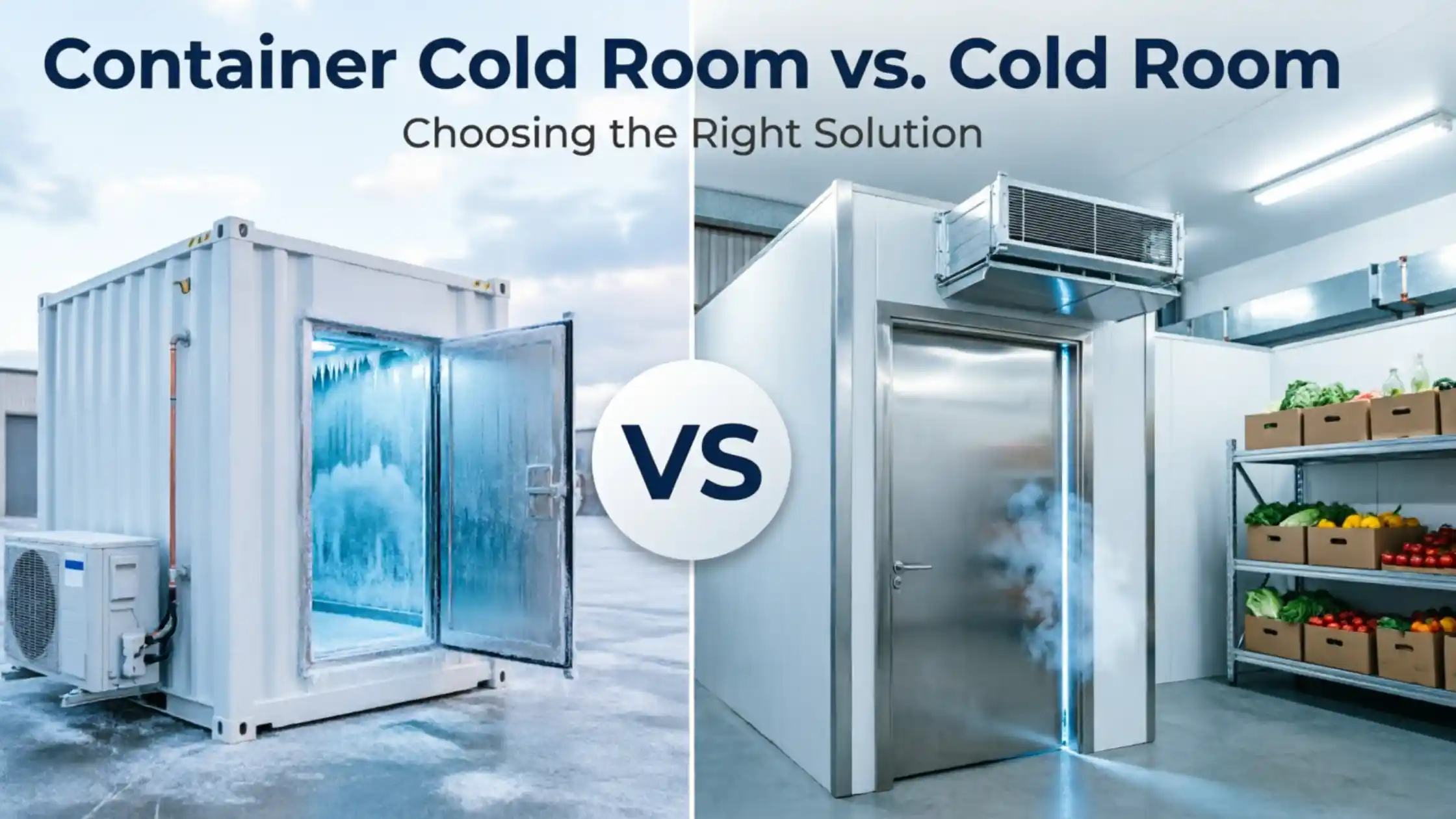
If you’re setting up cold storage in the UAE, you’ll run into two very different paths fairly quickly: a container cold room built from a converted shipping container or a traditional cold room built on-site with insulated panels. Both keep your products cold. Both can be made to keep exact temperature levels for drugs, foods, or flowers. But they handle the matter in different ways and with different costs and timing considerations. This article will show you how each system works, what each one is good at, and how to pick the best one for your business.
What Are Container Cold Rooms?
The Container Cold Room refers to a regular shipping container that has been modified to provide a refrigerated storage area. This involves insulating the steel body by lining it with high-density polyurethane (PU) panels, installing a refrigeration unit, and sealing the body such that it maintains a certain temperature irrespective of the ambient conditions. Since the container is the building itself, no additional structures have to be constructed.
You can see the full specification range on our container cold room product page, including chiller, freezer, and pharma-grade configurations.
How Do Container Cold Rooms Work?
Inside, it works the same way any cold storage system does — a refrigeration unit pulls heat out of the enclosed space and pushes it outside, while insulated panels stop that cold air from escaping. What makes a container cold room different is the shell. The corrugated steel container acts as the outer skin, so the insulation only has to do half the job a traditional building’s walls would. Units are typically pre-wired and pre-tested at the factory, so once it’s delivered and connected to power, it’s running within hours, not weeks.
Types of Container Cold Rooms
- Chiller Containers — hold produce, dairy, beverages, and flowers between 0°C and 10°C.
- Freezer Containers — built for meat, seafood, and frozen goods, typically -18°C to -25°C.
- Multi-Temperature / Multi-Zone Units — partitioned into two or more compartments running different temperatures at once.
- Pharma-Grade Containers — tightly controlled between +2°C and +8°C for vaccines, insulin, and lab samples, built to GDP standards.
- Custom Container Cold Rooms — sized and shelved for a specific use case, from event catering to seafood export.
What Are the Benefits of Container Cold Rooms?
- Fast deployment — delivered pre-built and operational within days, not the weeks a construction project needs.
- Portability — can be relocated to a new site, a new project, or resold if your needs change.
- Lower upfront cost — no civil works, foundations, or building permits eat into the budget.
- Built for the climate — the steel shell and marine-grade insulation are designed to handle UAE heat above 45°C.
- Easy to scale — add another unit next to the first one as your storage needs grow.
When to Use Container Cold Rooms
Container cold rooms make sense when speed matters, when the site is rented or temporary, or when the business doesn’t want capital tied up in permanent construction. That covers a lot of ground in the UAE — seafood exporters working out of leased warehouses, event and catering companies that need cooling for a season, flower distributors needing extra capacity during peak demand and companies expanding into new emirates or into African markets without wanting to build from scratch at every location.
What Are Cold Rooms?
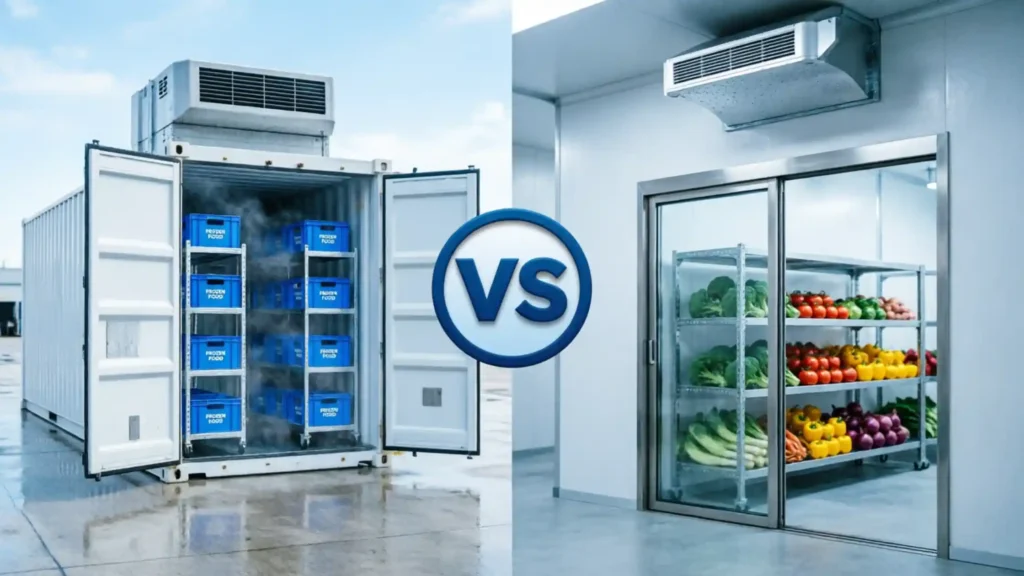
A traditional cold room is a permanent, purpose-built structure — either constructed as part of a building or assembled on-site using insulated panel systems anchored to a concrete floor. Instead of starting from a steel container, contractors build walls, ceiling, and flooring from scratch, fit refrigeration equipment sized to the space, and finish it as a fixed part of the facility.
How Do Cold Rooms Work?
The refrigeration principle is identical to a container cold room — compressors and evaporator coils remove heat from the space to hold a target temperature. The difference is in the way the enclosure is constructed. Insulated sandwich panels (core material being typically PU or PIR) are put up on site, caulked at all seams, and provided with strong doors and floor and even multiple refrigeration systems for larger volumes. The fact that it is custom made to fit precisely into the building space allows for more freedom of form.
Types of Cold Rooms
- Walk-In Cold Rooms — standard panel-built rooms for general chilled or frozen storage.
- Modular Panel Cold Rooms — built from prefabricated panels on-site, faster than pure masonry construction but still permanent.
- Blast Freezer Rooms — designed to rapidly bring products down to sub-zero temperatures before long-term storage.
- Large-Scale Distribution Cold Rooms — built for warehouses and distribution centers handling high storage volumes.
What Are the Benefits of Cold Rooms?
- Unlimited size and shape — not constrained by a container’s fixed dimensions.
- Built into the facility — integrates directly with loading docks, offices, or production lines.
- Long-term permanence — suited to businesses that know they’ll operate from the same site for years.
- Higher storage capacity — can be designed for very large inventories in one continuous space.
When to Use Cold Rooms
A conventional cold room is a more appropriate option if the business is the owner of the premises or has a long-term lease, requires extensive and odd-shaped storage area, or is establishing a permanent logistics center. Large retail stores, established food processing plants and pharmaceutical distributors generally prefer this option due to additional construction costs being worthwhile in the long term.
Common Uses of Container Cold Room and Cold Room
Both share the same industries, which include food and beverages, floral and produce, pharmaceuticals, seafood, and logistics. Their similarities lie in their capacity to maintain goods that require maintenance of temperature and their compliance to UAE’s food safety and GDP. Their distinctions are based on their environment, wherein companies that test markets or are doing a temporary business or even use a rented place will go for a container cold room, whereas a company that has a permanent place will use a built cold room.
Comparison: Container Cold Room vs. Cold Room
| Factor | Container Cold Room | Traditional Cold Room |
| Setup Time | Days (prefabricated, plug-and-play) | Weeks (on-site construction) |
| Mobility | Fully portable, can be relocated or resold | Fixed, permanent structure |
| Upfront Cost | Lower — no civil work required | Higher — includes construction & civil work |
| Space Requirement | Compact footprint, works on rented land | Needs dedicated built area |
| Best For | SMEs, seasonal use, remote/rental sites | Large permanent facilities, big-box storage |
| Weatherproofing | Steel container shell, built for harsh climates | Depends on building envelope quality |
| Scalability | Add units side by side as demand grows | Requires new construction to expand |
| Approval & Permits | Minimal, often no construction permit needed | Building permits and civil approvals required |
We’ve also broken down the cost side of this decision in detail in our guide on cold room cost vs. container cold room, if budget is the deciding factor for your project.
Which One Should You Choose?
There isn’t a universally right answer — only the right answer for your site, timeline, and budget. If you need cooling running this month, want the flexibility to move or resell the unit later, or you’re operating from a leased plot, a container cold room is almost always the smarter, faster route. If you’re building a permanent facility with large or irregular storage needs and you have the time and budget for construction, a traditional cold room gives you more room to design around your exact requirements.
At ContainerColdRoom.ae, a division of Technocrew Technical Services LLC, we manufacture container cold rooms built specifically for UAE and African market conditions — chillers, freezers, multi-zone, and pharma-grade units, delivered ready to plug in.
Get in touch through our About Us page or reach out directly for a free consultation on the right cold storage solution for your business.
1. Is a container cold room as reliable as a traditional cold room?
Yes. The refrigeration technology inside both is the same. A well-built container cold room, insulated and sealed properly, holds temperature just as consistently as a panel-built cold room — the steel container shell actually adds extra structural protection against UAE heat and weather.
2. How much time will it take to install the container cold room in comparison to the traditional cold room?
The container cold room will be already pre-built, therefore, it will only require few days for installation. In contrast, traditional cold room requires construction at the site with erection of panels and electrical wiring. This process will take few weeks.
3. Is it possible to move the container cold room after installation?
This is one of the main advantages of such a cold room. It can be easily lifted, moved to a new location or sold if it is not required anymore for your business due to its prefabricated nature.
4. Which of these two options is cheaper for a small business?
The container cold room is cheaper because it does not require civil works and you can extend its volume through adding extra units. Traditional cold rooms are more profitable to use when you operate at a large scale for many years.
5. Are container cold rooms compliant with pharma and food regulations in the UAE?
Yes, since container cold rooms that are made to the pharma standard will have the capacity of storing goods within the required +2°C to +8°C range in accordance with GDP, while food-grade container cold rooms will be compliant with the same hygiene standards of a commercial facility.
6. What size should I opt for?
This is dependent on your storage volume and product type, with 10ft for small enterprises or as extra space, 20ft covering most of SME requirements, and 40ft for large enterprises and more than one container unit.