

Dubai’s Growing Need for Flexible Cold Storage
If you’ve tried to lease warehouse space in Dubai over the last couple of years, you already know the problem. Good units get snapped up fast, rents keep climbing, and anything with proper cooling infrastructure is even harder to find. For businesses that live and die by temperature control — food distributors, pharma suppliers, florists, hospitality groups — that shortage isn’t just annoying. It’s a real bottleneck on growth.
The usual answer used to be simple: build a permanent cold room inside your warehouse. But permanent builds take time, need structural work, and lock you into one location. When you need extra capacity next quarter, not next year, that timeline doesn’t work.
This is where container cold rooms have quietly become the practical middle ground. They give businesses working cold storage in weeks instead of months, without the disruption of a full construction project. This article breaks down how container cold rooms actually work, how they stack up against permanent builds, and how to figure out which option genuinely fits your business — not just which one sounds trendier.
What Is a Container Cold Room?
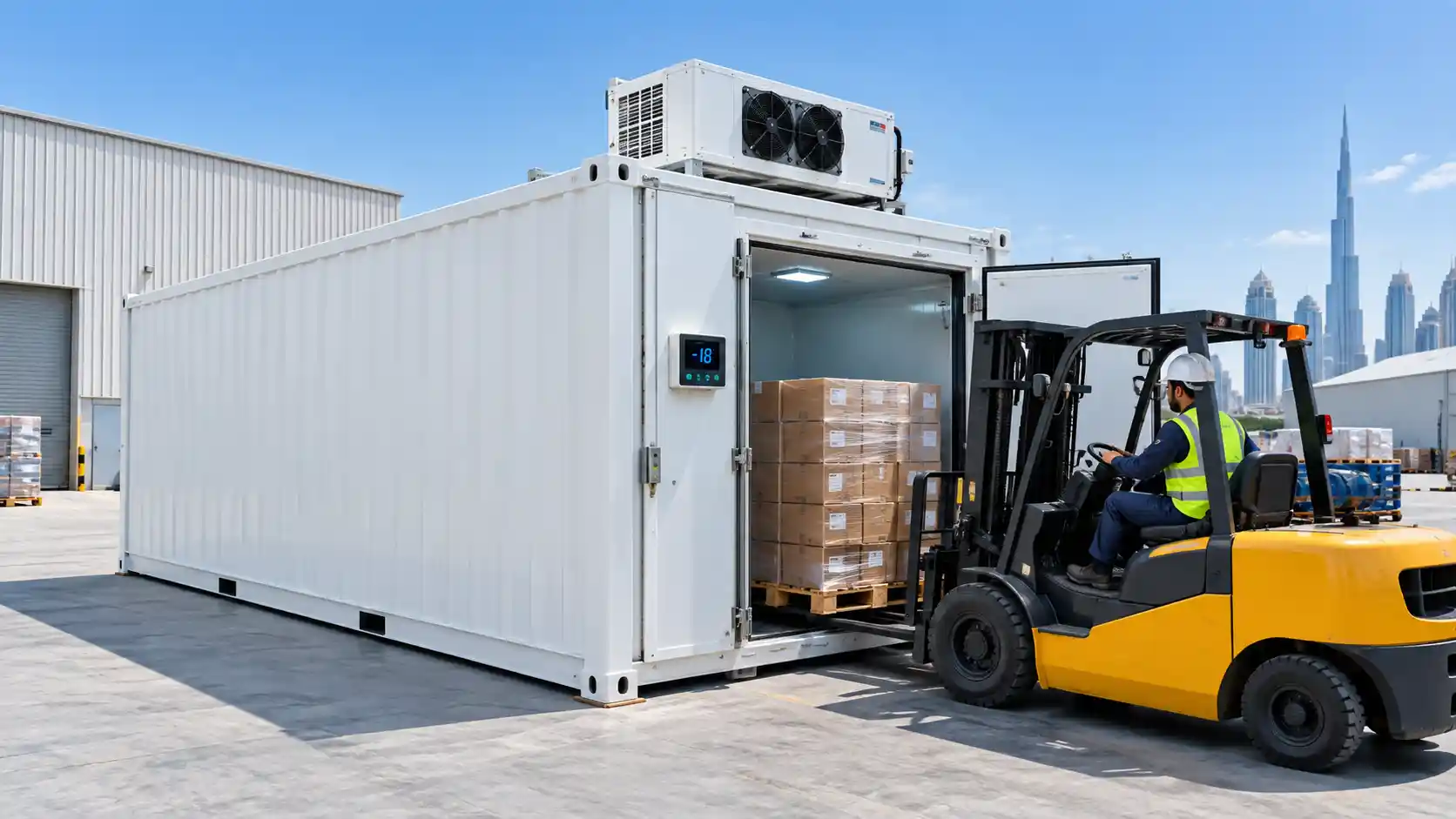
The term “container cold room” says it all, as this is a shipping container that has been modified to serve as an insulated and temperature-controlled storage facility. Instead of constructing walls inside an already available warehouse using concrete, you are looking at a self-contained unit that will be almost fully operational once it arrives.
The interior of the container will have insulated panels placed on the walls, since this is very important in the climate of Dubai. Also, there will be an installed refrigerating unit, which can reduce the temperature inside the unit to the desired levels for the type of products you intend to store — a container chiller for mild temperatures suited to flowers and vegetables, or a container freezer for the deepest freeze needed for meats and seafood. The temperature of the cold room is monitored digitally through temperature-controlled container systems.
Key Features of Container Cold Rooms
- Insulated panels that maintain stable internal temperatures despite outdoor heat
- Refrigeration systems sized to the container and the product being stored
- Temperature monitoring for compliance and peace of mind
- Door and access systems designed for regular loading and unloading
- Optional shelving or racking to organize inventory efficiently
- Energy-efficient operation, which matters when running costs add up over months of use
Because the unit is essentially a finished product on delivery, businesses can go from “we need more cold storage” to “we have more cold storage” far faster than with a construction project.
What Is a Permanent Cold Room?
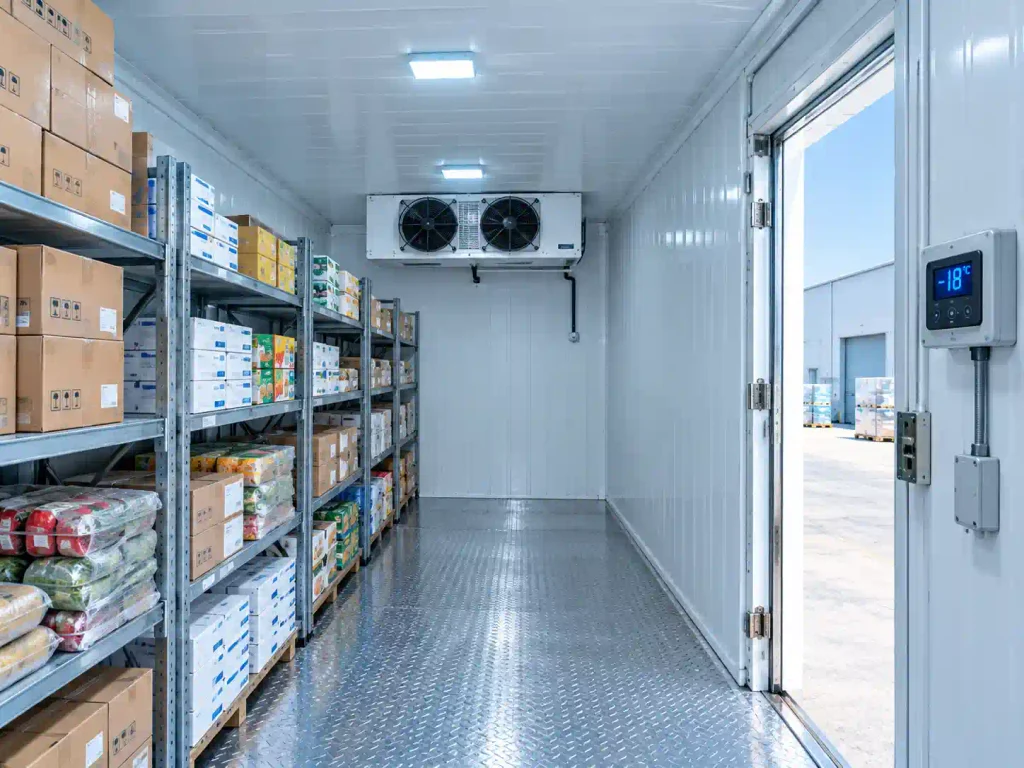
The traditional method of doing things would be building a permanent cold room — right in the warehouse where you already operate. Again, there will be use of panels and refrigeration systems, but all of these will have to be done at the site, and that requires wiring and other structural modifications.
A permanent cold room makes sense if you are planning to operate in one place for a long time and have a substantial requirement of space. The downside is obviously that of time and flexibility because once it is constructed, it cannot be moved or relocated.
Container Cold Rooms vs. Permanent Cold Rooms
Here’s a side-by-side look at how the two approaches compare on the factors that actually matter to a business making this decision.
| Factor | Container Cold Room | Permanent Cold Room |
| Installation time | Faster | Longer |
| Construction work | Minimal | More extensive |
| Warehouse space | Flexible | Requires dedicated space |
| Relocation | Possible | Difficult |
| Scalability | Easier | More complex |
| Initial construction | Lower complexity | Higher complexity |
| Long-term use | Flexible | Best for fixed locations |
| Business disruption | Lower | Potentially higher |
For B2B decision-makers, this table is often the starting point of the conversation — not because one option is objectively “better,” but because it clarifies which trade-offs your business is actually willing to make.
Why Container Cold Rooms Are Useful During Dubai’s Warehouse Shortage
Faster Deployment
When warehouse space is tight, waiting six to twelve months for a construction project isn’t realistic. Container cold rooms let businesses add cold-storage capacity in a fraction of that time, which matters when demand is already there and growing.
Better Use of Available Space
Containers can be placed in suitable commercial or industrial plots where permitted, which opens up options beyond whatever warehouse space happens to be available on the market right now.
Flexible Capacity
Need more room in six months? Add another unit. This kind of incremental scaling is far simpler than expanding a permanent structure, which usually means going back through design and construction all over again.
Reduced Construction Requirements
Because the insulation and refrigeration work is largely done before the unit arrives, there’s typically far less structural modification required on-site compared to a ground-up permanent build.
Useful for Temporary or Expanding Operations
Businesses with seasonal spikes — think flower wholesalers around major holidays, or food distributors during peak season — often don’t need permanent capacity year-round. A container unit gives them the flexibility to scale up and down as demand shifts.
Which Dubai Businesses Can Benefit from Container Cold Rooms?
Container cold rooms aren’t a niche product — they’re used across a wide range of B2B sectors in the UAE, including:
- Food distributors
- Restaurants and catering companies
- Supermarkets
- Hotels
- Meat and seafood businesses
- Fruit and vegetable suppliers
- Pharmaceutical and healthcare businesses
- Flower wholesalers
- Food importers and exporters
- Logistics and cold-chain companies relying on reefer containers for transport and storage
When Should You Choose a Container Cold Room?
A container cold room is generally a strong fit when:
- You need cold storage quickly, not months from now
- Your existing warehouse space is limited or fully utilized
- Your business is actively expanding
- Demand for storage is seasonal rather than constant
- You might need to relocate the facility down the line
- You want extra capacity without a major construction project
When Is a Permanent Cold Room a Better Choice?
To keep things balanced, it’s worth being upfront that container cold rooms aren’t the right fit for everyone. A permanent cold room tends to make more sense when:
- The facility is intended for long-term, fixed use
- A dedicated warehouse space is already available
- Large, fixed storage capacity is required
- Long-term demand is predictable and stable
- Integration with existing warehouse systems is a priority
Factors to Consider Before Choosing a Container Cold Room
Before committing to either option, it helps to think through:
- Required storage capacity — how much product needs to fit
- Required temperature range — chilled versus frozen storage needs differ significantly
- Available installation space — including access for loading vehicles
- Electricity requirements — refrigeration systems need reliable power supply
- Product loading and unloading — how frequently and how the goods move in and out
- Refrigeration capacity — matched correctly to container size and product type
- Insulation quality — critical for maintaining temperature efficiently in Dubai’s heat
- Maintenance and service — ongoing support to keep the unit running properly
- Local site and regulatory requirements — zoning and placement rules where the unit will sit
If your storage volumes fluctuate or you’re not ready to commit to a brand-new build, used reefer containers can also be a cost-effective starting point worth asking your supplier about.
How Much Does a Container Cold Room Cost in Dubai?
There’s no single fixed price that applies across the board, and any supplier quoting a flat number without knowing your requirements should raise a flag. Cost depends on several variables working together:
- Container size
- Temperature requirement
- Insulation specification
- Refrigeration system
- Door configuration
- Flooring
- Monitoring systems
- Installation
- Electrical work
- Customization
Because these factors vary so much from one business to another, the most useful next step is usually a customized quotation based on your actual storage capacity and temperature needs rather than a generic price list.
Container Cold Room ROI for UAE Businesses
While every project is different, businesses generally see value from container cold rooms through:
- Faster, revenue-generating deployment compared to waiting on construction
- Reduced construction requirements and associated costs
- Additional storage capacity without a full warehouse expansion
- Reduced product spoilage through consistent temperature control
- The ability to respond quickly to seasonal demand spikes
- Lower business disruption during setup, since existing operations don’t need to pause for construction
It’s worth being cautious here — no reputable supplier should promise guaranteed savings without real project data behind it. You can browse examples of completed installations in our project gallery to see how ROI plays out in practice. The honest answer is that ROI depends on how the unit is used and how well it’s matched to actual business needs.
Choosing the Right Container Cold Room Supplier in Dubai
Not all suppliers are equal, and the wrong choice can undo a lot of the flexibility container cold rooms are supposed to offer. Before signing on with anyone, check for:
- Genuine experience with commercial cold storage projects
- Strong refrigeration expertise, not just container fabrication
- Quality insulation materials suited to the UAE climate
- Energy-efficient equipment to keep running costs manageable
- Proper installation support, not just a drop-off
- Preventive maintenance programs
- Availability of spare parts
- Clear warranty terms
- Responsive after-sales service
- Ability to customize based on your specific product and space
Frequently Asked Questions
1.Is a container cold room appropriate for a business in Dubai?
Yes. These cold rooms are popularly utilized in many different sectors within the UAE, especially those that have limited warehousing space.
2.How fast can I install a container cold room?
The installation process is usually faster compared to a permanent one because much of the insulation and cooling processes have been done during manufacturing.
3.Which is more effective; a container cold room or a permanent cold room?
Neither of them is necessarily more effective –it depends on your requirement for fast installation and flexibility or permanence.
4.Can a container cold room be relocated?
Yes, this is one of the main advantages over permanent builds, which are effectively fixed in place once constructed.
What businesses use container cold rooms in the UAE?
Food distributors, restaurants, supermarkets, hotels, meat and seafood suppliers, flower wholesalers, pharmaceutical companies, and logistics operators, among others.
What should I check before installing a container cold room in Dubai?
Confirm site access, electrical supply, local zoning rules, required temperature range, and storage capacity before finalizing your setup.