

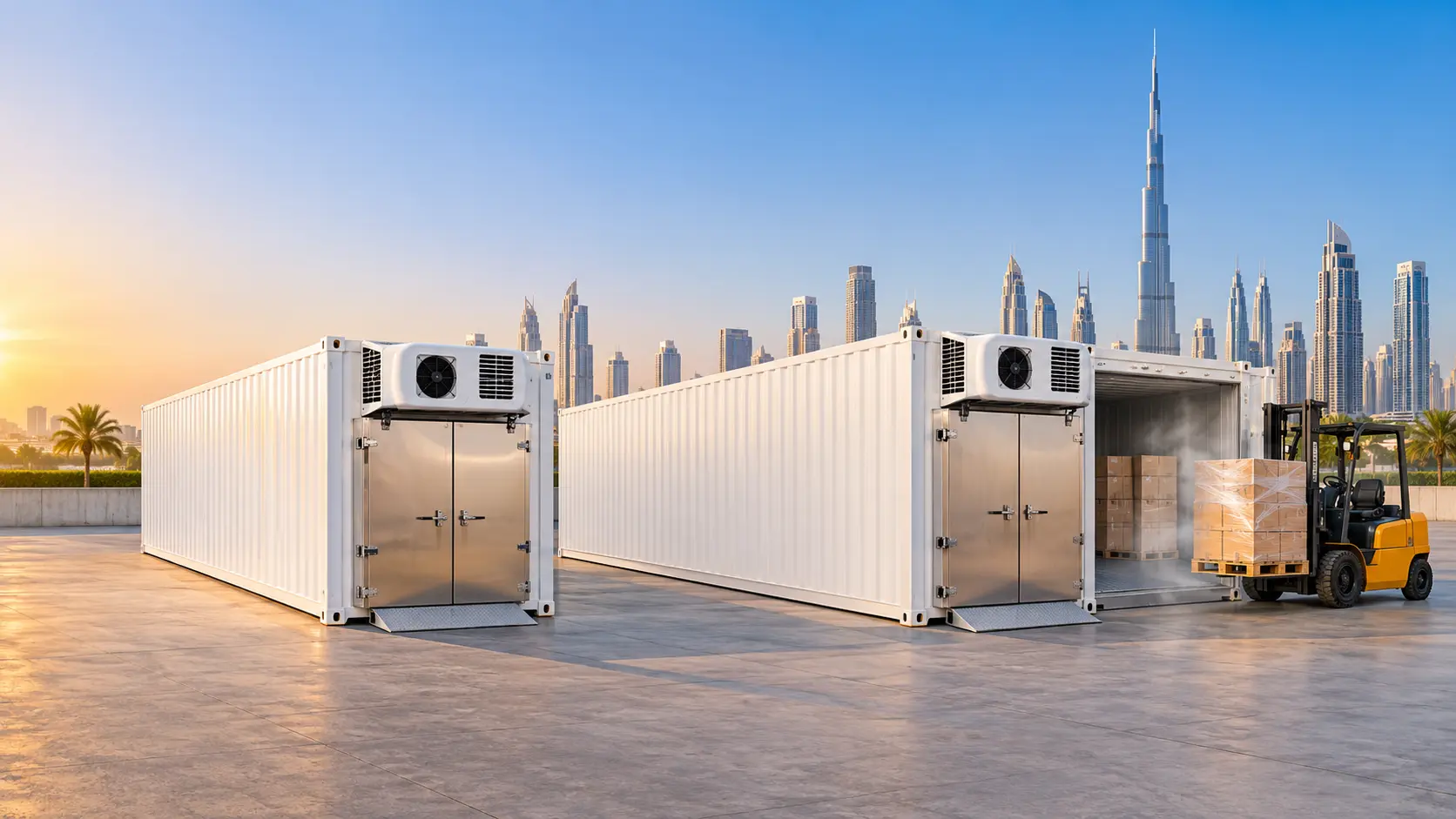
The topic of whether a 20- or 40-foot container cool room is necessary may eventually come up for everyone operating a food business, pharmaceutical distribution line, or events firm in the United Arab Emirates. It seems like a straightforward size decision
Actually, it affects your cash flow, your website’s design, your electricity cost, and how easily your business can grow over the next years.
This is not a pamphlet; rather, it helps you make decisions in the way that a practical person would. By the time it’s all over, you should know what to check for when placing an order and what size is best for your business.
The Quick Answer
The 20 feet container cold room is ideal for small to medium-sized storage purposes, typically accommodating about 10 pallets. The cold room is best for restaurants, caterers, event agencies, pharmaceutical distributors and short term projects. The 40 feet container cold room is ideal for businesses that require high volume of storage space, approximately 20 or more pallets. It is ideal for food importers, wholesalers, exporters and other businesses requiring one temperature controlled storage space.
20ft vs 40ft at a Glance
| 20ft Container Cold Room | 40ft Container Cold Room | |
| Approx. pallet capacity | Around 10 pallets | Around 20 or more pallets |
| Best for | Small to mid-size storage | High-volume storage |
| Site space needed | Compact | Long, clear footprint |
| Power load | Lower | Higher |
| Typical users | Restaurants, caterers, events, pharma distributors | Importers, wholesalers, exporters, large kitchens |
| Relocation | Easier to move and transport | Needs larger transport and crane planning |
| Flexibility | Easy to add a second unit later | One big space, less split-zone flexibility |
What Is a Container Cold Room, Exactly?
A container cold room is basically an insulated structure that resembles a shipping container, but which has been equipped with refrigeration equipment. In simple terms, this means that you can get your cold store delivered straight to your doorstep through a vehicle. This saves you the time and cost involved in construction.
This is one reason why it has gained popularity especially in Dubai, Abu Dhabi, and Sharjah. You can get your cold store up and running within days and you are not tied down to any particular location since you can move it when you need to.
The 20ft Container Cold Room: Compact and Flexible
A 20ft unit is the sensible starting point for many UAE businesses. It is about 6 metres long, so it fits in car park corners, loading yards, back lanes and small industrial plots that a bigger unit simply cannot reach.
Where it works well
- Restaurants and hotel kitchens that need extra chilled storage during peak season or Ramadan.
- Event and catering companies that need temporary cold storage for weddings, exhibitions and festivals.
- Pharma and healthcare distributors who handle moderate volumes and need steady temperatures.
- Small food traders who are growing but not ready to commit to a large cold warehouse.
The upsides
- Lower purchase or rental cost.
- Lower electricity use, which matters in the UAE summer when cooling systems work harder.
- Easy to transport and reposition.
- Simple to add a second unit later and run it as a separate temperature zone, for example one chiller and one freezer.
The trade-offs
The main limit is space. When you outgrow it, you outgrow it quickly. Businesses that expect fast growth sometimes buy a 20ft, fill it within a year and then have to buy again. Also, with only about 10 pallets of room, there is little spare space for racking, picking aisles and dividing stock.
The 40ft Container Cold Room: Built for Volume
A 40ft unit is roughly double the length and carries roughly double the pallets. It is the right tool when storage is central to how you make money, not just a back-up.
Where it works well
- Food importers and wholesalers who receive large shipments and need to store them quickly.
- Exporters, for example businesses sending goods to Africa, who need to stage and consolidate cargo before shipping.
- Large catering and central kitchen operations.
- Seasonal businesses that need a big temporary store for a few months each year.
The upsides
- One large space makes stock rotation and loading simpler for high-volume work.
- Better cost per pallet when you actually fill it.
- Room to organise aisles, racking and labelled zones.
The trade-offs
A 40ft unit needs a long, clear, level site with proper truck and crane access. It draws more power, so your electrical supply must be able to handle it. If you only half-fill it, you are paying to cool empty air. And moving it later is a bigger job than moving a 20ft.
Chiller or Freezer: Decide the Temperature First
Make sure you have your temperature settled first, since this affects all other aspects.
• Chiller (approximately +2°C to +8°C): fresh fruit/vegetables, dairy, beverages, flowers, most pharmaceutical products.
• Freezer (approximately -18°C to -25°C): frozen meat, seafood, frozen desserts, frozen ready meals.
A freezer is more powerful than a chiller, and consumes more energy, and thus a freezer 40ft container is an extremely heavy electric load. If you require both temperatures, two 20ft containers will suit you better than a single large container, as each container will be able to operate at their own setpoint.
Think About UAE Conditions
The UAE climate is not forgiving, and it should shape your decision.
- Summer heat: with outdoor temperatures above 45°C, the refrigeration system works harder. A unit sized too tightly for your needs will struggle. Ask for a system rated for high ambient temperatures.
- Power supply: confirm that your site has enough electrical capacity and the right connection before delivery. This is the most common cause of installation delays.
- Site preparation: you need level ground, clear access for a truck and, for larger units, space for a crane or lifting equipment.
- Shade and ventilation: a unit under shade or with good airflow around the condenser performs better and costs less to run.
- Local approvals: depending on your emirate and use case, you may need approvals, for example for food storage or pharmaceutical handling. Check with the relevant authority before you place your order.
Rent or Buy?
Size selection is usually determined by making such a choice.
Leasing is ideal for parties, peak seasons, trials, and projects. No initial capital investment is involved, while maintenance is typically done by the supplier. This is a great option to ensure you really need a 40ft container.
Purchase is ideal for companies that have steady storage needs on a continuous basis. In the long term, leasing will prove more expensive than buying, and you will be able to dispose of or relocate the asset in future.
An effective approach is to lease a 20ft container to establish your storage needs for some months before purchasing a proper-sized unit. Quotes may differ depending on specifications; therefore, it is advisable to request a quotation including delivery, installation and wiring costs.
Which Size Should You Choose? A Simple Checklist
Ask yourself these questions honestly:
- How many pallets do I store at peak? Under about 10 points to a 20ft. Above about 15 points to a 40ft.
- Do I need two temperatures? If yes, consider two 20ft units.
- Do I have a long, clear, level site? If not, a 20ft is the realistic choice.
- Can my power supply handle it? Confirm this before ordering anything.
- Will I grow in the next two years? If growth is likely, think about a 40ft or a plan to add a second 20ft.
- Is my need permanent or temporary? Temporary needs usually favour renting.
By business type:
- Restaurant or hotel kitchen: 20ft.
- Event or catering company: 20ft, rented, with a second unit for peak events.
- Pharma distributor: 20ft for moderate volume, with strict temperature monitoring.
- Food importer or wholesaler: 40ft.
- Exporter: 40ft, or two 20ft units if you handle mixed temperatures.
Mistakes to Avoid
- Buying for today only. Plan for where your business will be in 18 to 24 months.
- Ignoring power. A beautiful unit is useless without the right electrical connection.
- Choosing on price alone. Insulation quality, compressor rating and after-sales service decide whether the unit performs through a Dubai summer.
- Skipping monitoring. Especially for food and pharma, temperature logging protects your stock and your compliance record.
Why Talk to ContainerColdRoom.ae
The ContainerColdRoom.ae, which is run by the Technocrew Technical Services, based out of Dubai, provides cold room containers to firms in the UAE and other countries too. Irrespective of whether you need a small 20 ft container chiller or a big 40 ft chiller for importing purposes, we will ensure that we customize your requirement and not our sales quota. If you do not know which chiller is right for you, then do tell us about your products, premises, and future growth plans.
Frequently Asked Questions
A 20ft would hold up to 10 pallets while a 40ft will hold 20 or more pallets. It will however depend on the type and number of pallets as well as the spacing you allow within the container.
Yes. Renting is ideal for events, peak season periods, and trial periods, while many firms tend to begin with renting a 20-foot unit before purchasing one.
The chiller units operate between +2°C and +8°C, while freezer units operate between -18°C and -25°C. It all depends on the specification ordered.
The 40-foot container will need more power than the 20-foot, hence the need to ensure you have enough power supply. The requirements for permits will depend on your location as well as the items you will store in the room.
Yes, since many companies in the UAE export cold rooms to Africa.
It all depends on volume and space requirements. A 20ft container would be ideal for those businesses holding less than 10 pallets of products. A 40ft would be appropriate for those who hold more or are planning on growing.